The Future of Fitness Tracking Technology

May 13, 2024

Empowering Personal Healthcare with Wearables


In an era where health is becoming increasingly personalized, fitness tracking technology has emerged as a pivotal tool in promoting wellness and enhancing personal healthcare. Wearable devices like smartwatches and fitness bands have revolutionized the way we monitor and manage our physical activity, providing us with real-time insights into our health metrics and behaviors.

These devices go beyond simply counting steps; they now offer a comprehensive suite of features, including heart rate monitoring, sleep tracking, GPS navigation, and even stress management tools. With advancements in sensors and data analytics, the future of fitness tracking technology looks promising, poised to further elevate the user experience and accuracy of health monitoring.

One of the most significant impacts of fitness tracking technology lies in its ability to empower individuals to take control of their health. By providing actionable data and personalized recommendations, wearables facilitate informed decision-making and encourage users to adopt healthier habits. From motivating users to achieve their fitness goals to alerting them to potential health issues, these devices play a crucial role in preventive healthcare.

Looking ahead, the future of fitness-tracking technology holds immense innovation potential. We can anticipate more seamless integration with other healthcare systems, such as electronic health records, telemedicine platforms, and AI-driven diagnostics. Furthermore, advancements in battery life, biometric sensors, and data privacy measures will enhance the reliability and accessibility of wearable devices, making them indispensable companions for personal health management.

Fitness tracking technology is not just a trend; it's a transformative force in personal healthcare. As wearables continue to evolve and become more sophisticated, they will undoubtedly play a central role in promoting holistic well-being and empowering individuals to lead healthier, more active lives.

Exploring Abstract Collage Illustrations: Techniques and Adobe Illustrator Tips

April 29, 2024


Abstract collage illustrations are a fascinating art form that allows artists to express creativity through a combination of different elements, textures, and shapes. In this blog post, we'll delve into the world of abstract collage illustrations, exploring the techniques used to create them and how Adobe Illustrator can be a valuable tool in the process.


Techniques for Creating Abstract Collage Illustrations

1. Gathering Inspiration:

  • Before diving into the creation process, it's essential to gather inspiration from various sources such as nature, architecture, textures, and even everyday objects.
  • Look for interesting shapes, colors, and patterns that can serve as the foundation for your collage illustration.


2. Selecting Materials:

  • Choose a variety of materials to incorporate into your collage, such as paper scraps, fabric, photographs, and found objects.
  • Experiment with different textures and weights to add depth and visual interest to your composition.


3. Composition and Layout:

  • Start by sketching out rough ideas for your collage composition, considering the placement of each element within the illustration.
  • Play with scale, layering, and negative space to create a dynamic and visually engaging composition.


4. Cutting and Arranging:

  • Once you have a plan in place, begin cutting out your selected materials and arranging them on a surface.
  • Experiment with overlapping and juxtaposing elements to create visual contrast and movement within the illustration.


5. Adding Details and Texture:

  • Use additional techniques such as drawing, painting, or printing to add details and texture to your collage.
  • Consider using mixed media techniques to enhance the depth and complexity of your illustration.


Using Adobe Illustrator for Collage Illustrations

Adobe Illustrator can be a powerful tool for creating digital collage illustrations. Here are some tips for using Illustrator in your collage artwork:


1. Digitizing Your Collage:

  • Scan or photograph your physical collage and import it into Adobe Illustrator as a high-resolution image.


2. Tracing and Refinement:

  • Use the Pen Tool or Image Trace feature to trace the shapes and elements of your collage, creating clean vector paths.
  • Refine and edit the traced shapes as needed to achieve the desired look and feel for your illustration.


3. Adding Digital Elements:

  • Incorporate additional digital elements such as gradients, patterns, and textures to enhance your collage illustration.
  • Experiment with blending modes and layer effects to create depth and dimension within your artwork.


Abstract collage illustrations offer a unique opportunity for artists to explore creativity and experimentation. By combining traditional collage techniques with digital tools like Adobe Illustrator, artists can create captivating and visually stunning artwork that pushes the boundaries of traditional illustration. Whether you're a seasoned artist or just starting, experimenting with abstract collage illustrations can be a rewarding and inspiring journey.


Image Source: 

https://webexahead.webex.com/the-culture-factor-how-hybrid-work-is-advancing-around-the-world/

https://www.behance.net/gallery/75636593/Bauhaus-feeling-Collage


PUBG Mobile Vikendi Snow Map Release Date and Start Time Announced

December 18, 2018

HIGHLIGHTS

  • Vikendi is a part of the 0.10.0 update
  • It is the fourth map in the game following Erangel, Miramar, and Sanhok
  • It is playable from 5:30am IST on December 21

The PUBG Mobile 0.10.0 brought support for the Vikendi map and now Tencent has confirmed when you can play it. According to a tweet from the official PUBG Mobile account, the PUBG Mobile Vikendi Snow Map release date is December 20 and the start time and date is 5:30am IST on December 21 when it would be available for matchmaking. Earlier today, administrators of the official PUBG Mobile Discord stated that there was no definite timeline for when Vikendi could be played. Evidently this has changed. Before you can get the Vikendi map though, you'll need to download the PUBG Mobile 0.10.0 update that has a 2.1GB download size.

What this means is, PUBG Mobile could be the first version of PUBG to get Vikendi outside of PUBG public test servers, where it's playable for PC users. The PUBG Vikendi snow map is now live in PUBG PC PTS or Public Test Server as it is known. So if you bought PUBG on PC, you can check out Vikendi before its available in the main game. While no date has been given for Vikendi for PUBG Xbox One and PS4, it's safe to say that it would be available soon considering it was added to the PUBG PS4 PTS.

Other additions to PUBG PTS include the G64 rifle and a snowmobile. It's speculated that PUBG Vikendi PTS for PS4 and Xbox One will be live in early January and its full release will bring the Vikendi Event Pass along with it. Though we won't be surprised to see it hit earlier in order for PUBG to stay competitive with the likes of Fortnite and Overwatch, both of which have winter-themed events underway.

As for PUBG Mobile, Vikendi isn't the only thing new. With the PUBG Mobile 0.10.0 update comes a reporting system allowing players to report suspicious behaviour while spectating a match on death. Cross-server matchmaking has been added too. When enabled players have a chance to be matched with those of the same tier on other servers. Also new in the PUBG Mobile 0.10. update is the Firearms Finish Upgrade System. This lets players upgrade weapon finishes to get new kill effects, broadcasts, and death crate appearances.

VAR at the World Cup: What is the technology being used in Russia and how does it work?

June 19, 2018
The World Cup will put the greatest footballing nations on Earth to the test. But there is another trial happening, perhaps just as important and even more controversial: that of VAR, or the video assistant referee.

The technology is being used at the World Cup for the first ever time, and has the potential to fundamentally change games. It could decide the future of the tournament, by reversing some of the most important refereeing decisions in the game.

Proponents claim that VAR will ensure that decisions are fair and that the best team wins. But even those supporters admit that the technology is still at a very early stage – with supporters and referees still apparently confused about how it should actually be used.

How will VAR work in the Premier League?


Despite that complexity, the technology is fundamentally incredibly simple: it is an extra referee who watches the game and advises officials on decisions. In practise, though, it might be very complicated indeed.

How does it work?

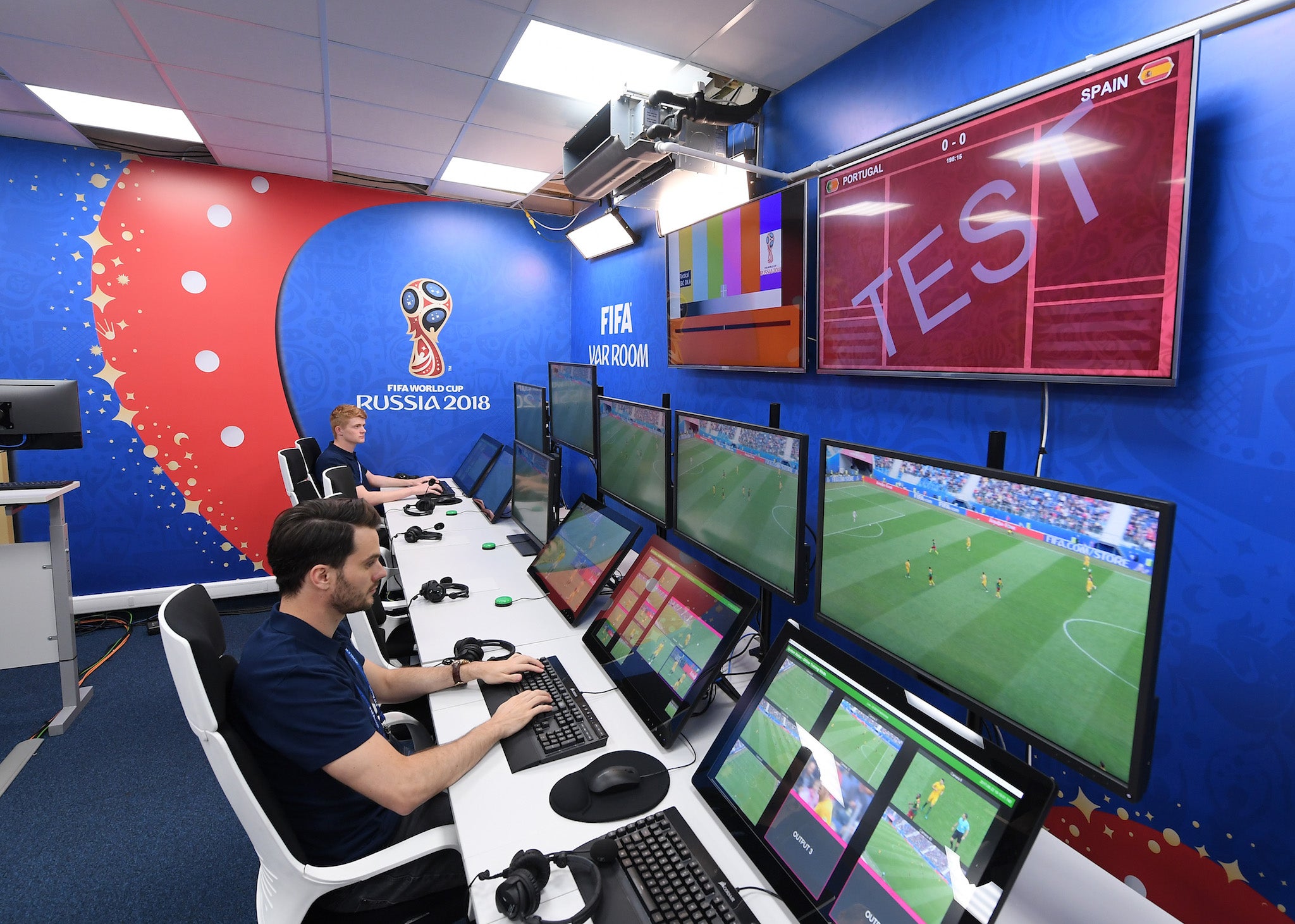
There are 13 officials who can be chosen as the video assistant referee. They will all sit in a special hub in Moscow – no matter where the game is happening – and they will do so wearing their full kit, as if they were ready to jump onto the pitch at any time.

Of those, one will be chosen for each game, and they will have a team of three assistants.
In there, they will receive a stream from inside the stadium, which is made up of the view from a whole host of cameras – including slow motion ones – which the referees can flick between.

The VAR will watch the whole of each game. If they see something wrong, they can flag it to the referee; if the referee thinks something is wrong, he can get in touch with the VAR.

Either way, the VAR is only advisory. Any decision ultimately rests with the referee, even if he has advised the opposite way by the VAR.


A general view of the Video Assistant Referee's Room home of the VAR system to be used at all FIFA World Cup matches during the Official Opening of the International Broadcast Centre on June 9, 2018 in Moscow, Russia (Laurence Griffiths/Getty Images)

What can be referred to the video referee?

Fifa might have allowed the technology into the World Cup. But they have severely limited the kinds of decisions it can actually be used for.

In total, there are four different sorts of incident that can be reviewed:
  • Goals. The system can be used to check if a goal actually went in, in the obvious way. But it can also adjudicate on the lead-up to the goal, not just the ball passing into the net – if an infringement would have stopped the goal being rewarded, then VAR can stop it being awarded.
  • Penalties. This can go either way, being used to check whether a penalty should have been awarded and wasn't, but also reversing the decision if a foul is given in the penalty box.
  • Red cards. If the referee has decided a foul has been committed, then VAR can be used to decide whether a red card should be awarded. This might be the most controversial thing that the video technology will be relied on for, for reasons we will get onto later.
  • Mistaken identity. Probably the most vague but also important parts of VAR's responsibility, this will allow the additional referees to spot if the wrong player has been disciplined. If they are, the referee will be corrected. That should stop situations like the mix-up between Kieran Gibbs and Alex Oxlade-Chamberlain that saw the wrong player sent off during a match in 2014.


How do you know when it's happening?

The entire system of VAR is focused around the referees, not around spectators. Which means the priority is not on making clear when or whether the system is being used.

It can be engaged in one of three ways.

In some situations, the referee might simply get a message in their earpiece, indicating that a decision is being reviewed. They'll get word from the VAR referees, who might tell them to change or stick with a decision. Spectators might not even know this is happening, or just see the referee touch their earpiece.

Another sees the video process engaged more formally, and the referee will draw a rectangle in the air to indicate a TV. That can be triggered by either the referee or the VAR judges, who will again have a word through the earpiece. The decision will be relayed to the referee, who will then make the rectangle sign again and carry on with the match.

The final one is the most clear, but could be the most confusing and frustrating in the stadium. Referees will head over to a small reviewing station on the side of the pitch – making the TV sign as they do – where they will also be able to see the same replays that are being shown to the VAR officials. They'll then consult together and make their decision.

In all cases, the decision will be made clear in the normal way – by the traditional referee signalling the decision, in the same way as without VAR. They might make the rectangle TV sign in the air to indicate how the decision was made, but then will continue in the usual way.

What can spectators see?

Perhaps the strangest and most confusing part of VAR is the fact that spectators won't actually get to see any of the replays, or even necessarily know what is happening. At most, they'll see the referee make the TV screen sign and perhaps head off to watch the pitch-side review.

But viewers at home will get to see the same pictures the referees are being shown, so the decision should not be quite so shocking. (This only goes one way: the referees don't get to see any broadcast images, or hear any commentary.)

Does it make any difference to players?

In the more direct sense – that is, discounting any arguments about whether it will change the pace of games – VAR doesn't allow players to do anything specific. In fact, the only significant rule change is what players can't do: they must not make the VAR sign themselves, in the same way they can't pretend to hold up a yellow card to someone as part of a protest, and they can be booked if they try it.

Why is it so controversial?
It took a long time for VAR to be introduced. And that was partly because many people fear it could ruin the flow and feel of the game.

Critics suggest that referees flagging up decisions using VAR – and then taking time to review footage and make their decision – could cause disruptions in play. And they also suggest that it will take away the important nuance that is part of refereeing, butting into matches to decide on any incident that relies on shades of grey.

Proponents have dismissed that idea. Earlier this year, refereeing body PGMOL stressed that the system would only interrupt games when there were very clear problems – "the rule of thumb is essentially 'if it’s not clear and obvious, leave it', and 'minimum interference, maximum benefit'," The Independent's Miguel Delaney wrote at the time.

But in use, the technology has been far from clear.

At a friendly match between Italy and England just weeks ago, a bizarre decision saw the video referee award a penalty – but that fact came after minutes of unexplained contemplation, and was not very well communicated to spectators. That came after similar events at Tottenham, which saw Spurs have two games disallowed during an FA Cup game, but after a lengthy disruption to play.

Officials might now be more used to using the technology, and working together. But we won't know until a World Cup match is interrupted.

Are there any changes being made for the World Cup?

The previous confusing instances have led to some changes for this competition. Fifa will be able to use a special tablet to send information to spectators and broadcasters, which should hopefully give them a bit more of a sense of what is actually happening while decisions are being made.

Is it likely to make a difference to decisions?

A study released this week found that slow-motion videos and real-time ones mostly led to the same decisions: in the experiment, referees were 63 per cent right when they watched an incident slowed down, compared with 61 per cent at normal speed.

But it found that slowing down videos seemed to severely change the way that referees saw intention. Watching in slow-motion made them far more likely to think that a foul had been done on purpose – and therefore considerably more likely to give a red card.

By
Andrew Griffin 
Jun 16, 2018

Google says its AI is better at predicting death than hospitals

June 19, 2018

Google’s Medical Brain team is now training its AI to predict the death risk among hospital patients — and its early results show it has slightly higher accuracy than a hospital’s own warning system.

Bloomberg describes the healthcare potential of the Medical Brain’s findings, including its ability to use previously unusable information in order to reach its predictions. The AI, once fed this data, made predictions about the likelihood of death, discharge, and readmission.

In a paper published in Nature in May, from Google’s team, it says of its predictive algorithm:

These models outperformed traditional, clinically-used predictive models in all cases. We believe that this approach can be used to create accurate and scalable predictions for a variety of clinical scenarios.

In one major case study in the findings, Google applied its algorithm to a patient with metastatic breast cancer. 24 hours after she was admitted, Google gave her a 19.9 percent chance of dying in the hospital, in contrast with the 9.3 estimate with the hospital’s augmented Early Warning Score. Less than 2 weeks later, the patient died from her condition.

In order to come to that number, the AI tallied 175,639 data points from the patient’s electronic medical records, including handwritten notes. According to the paper, this is the difference between Google’s work and previous deep learning approaches:

In general, prior work has focused on a subset of features available in the EHR, rather than on all data available in an EHR, which includes clinical free-text notes, as well as large amounts of structured and semi-structured data.

In its whole study, Google analyzed 216,221 hospitalizations with 114,003 patients — and over 46 billion data points from all of their electronic health records.

This isn’t the first time Google’s AI has been applied to predictive healthcare. Earlier this year, DeepMind partnered with the Department of Veterans Affairs to feed its AI 700,000 medical records from veterans in order to predict deadly changes in patient condition.

The company is also working to develop a voice recognition system for clinical notes which will eliminate the need for doctors to type them in. In that particular case, the challenge comes from inaccuracy — even the smallest mistakes in a patient’s record can result in them getting the wrong care. Dr Steven Lin, who spearheaded the research with Google, told CNBC:

This is even more of a complicated, hard problem than we originally thought. But if solved, it can potentially unshackle physicians from EHRs and bring providers back to the joys of medicine: actually interacting with patients.

If Google can both smooth the process of entering data and improve the means by which that data is used, it could cut down on human error in medical care.

The company’s greatest challenge — the data in this case isn’t available for security reasons. In 2016, the company faced backlash from patients when it was revealed it’d gained access to the data of 1.6 million patients — without consent — from three hospitals in London in order to develop an app which notified doctors when a patient was likely to get kidney disease.

It could also stoke fears of an AI having too much say over who gets what care. If a patient is given a significantly higher risk than another, will the hospital allocate more resources to the former based on the AI’s prediction?

By
Rachel Kaser
Jun 19, 2018

“Learn with Google AI” website offers free machine learning education for all

June 17, 2018
Google introduces “Learn with Google AI” website to educate people about machine learning and AI for free

Artificial Intelligence (AI) and machine learning (ML) are currently some of the trending topics in the tech industry. Google wants to make AI and ML more accessible to more people by providing lessons, tutorials and hands-on exercises at all experience levels.

Therefore, Google India on Thursday (March 1) introduced a new website called “Learn with Google AI” that encourages everyone to understand how AI works, learn about core ML concepts, develop skills and apply AI to solve real-world challenging problems. These educational resources are developed by ML experts at the company and caters to everyone, from beginners to researchers looking for advanced tutorials.

“We believe it’s important that the development of AI reflects as diverse a range of human perspectives and needs as possible. So, Google AI is making it easier for everyone to learn ML by providing a huge range of free, in-depth educational content,” Zuri Kemp, Programme Manager for Google’s machine learning education, said in a statement.

“This is for everyone — from deep ML experts looking for advanced developer tutorials and materials, to curious people who are ready to try to learn what ML is in the first place,” Kemp added.

“Learn with Google AI” also offers a free online course called the new Machine Learning Crash Course (MLCC), which features videos from ML experts at Google, interactive visualizations illustrating ML concepts, coding exercises using cutting-edge TensorFlow (TF) APIs, and A focus that teaches how practitioners implement ML in the real world.

“Our engineering education team originally developed this fast-paced, practical introduction to machine learning fundamentals for Googlers. So far, more than 18,000 Googlers have enrolled in MLCC, applying lessons from the course to enhance camera calibration for Daydream devices, build virtual reality for Google Earth, and improve streaming quality at YouTube. MLCC’s success at Google inspired us to make it available to everyone,” added Kemp.

The course’s duration is estimated at 15 hours, with interactive lessons, lectures from Google researchers, and over 40 exercises included. The course can be availed by newcomers as well as those who have no experience in ML. However, Google suggests that students should have proficiency at least in intro-level algebra, programming basics, and Python.

“There’s more to come from Learn with Google AI, including additional courses and documentation. We’re excited to help everyone learn more about AI,” said Kemp.

By Kavita Iyer
March 4, 2018

2018 FIFA World Cup

June 13, 2018

The 2018 FIFA World Cup will be the 21st FIFA World Cup, a quadrennial international football tournament contested by the men's national teams of the member associations of FIFA. It is scheduled to take place in Russia from 14 June to 15 July 2018, after the country was awarded the hosting rights on 2 December 2010.
The final tournament will involve 32 national teams, which include 31 teams determined through qualifying competitions and the automatically qualified host team. Of the 32 teams, 20 will be making back-to-back appearances following the last tournament in 2014, including defending champions Germany, while Iceland and Panama will both be making their first appearances at a FIFA World Cup. A total of 64 matches will be played in 12 venues located in 11 cities. The final will take place on 15 July at the Luzhniki Stadium in Moscow.


Source: https://en.wikipedia.org/wiki/2018_FIFA_World_Cup

2018 FIFA World Cup Team


Source: https://www.fifa.com/worldcup/teams/

FIFA World Cup 2018 Stadiums

Teams: 32
Playing venues: 12
Matches: 65
Opening match: Luzhniki Stadium
Final: Luzhniki Stadium
Average venue capacity: 49,300 seats
Largest venue: Luzhniki Stadium (81,000 seats)
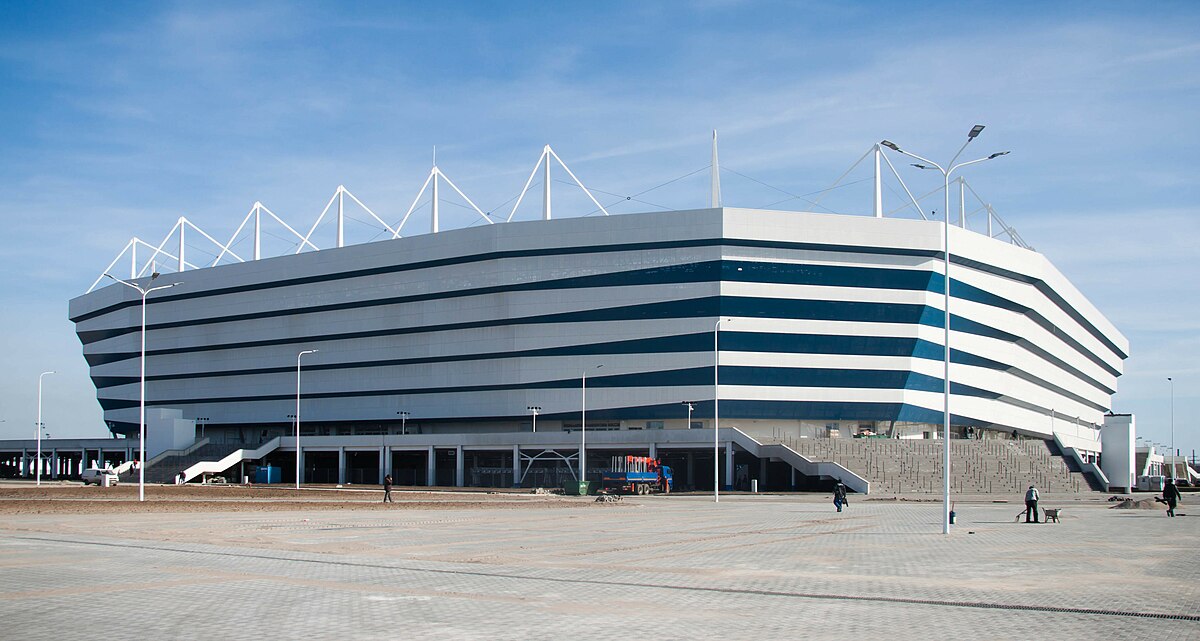
Smallest venue: Kaliningrad Stadium (35,212 seats)
Average no. of matches per venue: 5.33

Moscow
Luzhniki Stadium | Capacity: 80,000 seats | Opening: 1956
Matches:
14 June 2018 18:00 – Russia vs Saudi Arabia – Group A
17 June 2018 18:00 – Germany vs Mexico – Group F
20 June 2018 15:00 – Portugal vs Morocco – Group B
26 June 2018 17:00 – Denmark vs France – Group C
1 July 2018 17:00 – 1B vs 2A – Round of 16
11 July 2018 21:00 – W59 vs W60 – Semi Final
15 July 2018 18:00 – W61 vs W62 – Final

Saint Petersburg
Saint Petersburg Stadium | Capacity: 67,000 seats | Opening: 2017
Matches:
15 June 2018 17:00 – Morocco vs Iran – Group B
19 June 2018 21:00 – Russia vs Egypt – Group A
22 June 2018 15:00 – Brazil vs Costa Rica – Group E
26 June 2018 21:00 – Nigeria vs Argentina – Group D
3 July 2018 17:00 – 1F vs 2E – Round of 16
10 July 2018 21:00 – W57 vs W58 – Semi Final
14 July 2018 17:00 – L61 vs L62 – Third Place

Sochi
Fisht Stadium | Capacity: 48,000 seats | Opening: 2013
Matches:
15 June 2018 21:00 – Portugal vs Spain – Group B
18 June 2018 18:00 – Belgium vs Panama – Group G
23 June 2018 18:00 – Germany vs Sweden – Group F
26 June 2018 17:00 – Australia vs Peru – Group C
30 June 2018 21:00 – 1A vs 2B – Round of 16
7 July 2018 21:00 – W51 vs W52 – Quarter Final

Ekaterinburg
Ekaterinburg Arena | Capacity: 45,000 seats | Opening: 1957

Matches:
15 June 2018 17:00 – Egypt vs Uruguay – Group A
21 June 2018 17:00 – France vs Peru – Group C
24 June 2018 20:00 – Japan vs Senegal – Group H
27 June 2018 19:00 – Mexico vs Sweden – Group F

Kazan
Kazan Arena | Capacity: 45,000 seats | Opening: 2013

Matches:
16 June 2018 13:00 – France vs Australia – Group C
20 June 2018 21:00 – Iran vs Spain – Group B
24 June 2018 21:00 – Poland vs Colombia – Group H
27 June 2018 17:00 – Korea Republic vs Germany – Group F
30 June 2018 17:00 – 1C vs 2D – Round of 16
6 July 2018 21:00 – W53 vs W54 – Quarter Final

Nizhny Novgorod
Nizhny Novgorod Stadium | Capacity: 45,000 seats | Opening: 2018

Matches:
18 June 2018 15:00 – Sweden vs Korea Republic – Group F
21 June 2018 21:00 – Argentina vs Croatia – Group D
24 June 2018 15:00 – England vs Panama – Group G
27 June 2018 21:00 – Switzerland vs Costa Rica – Group E
1 July 2018 21:00 – 1D vs 2C – Round of 16
6 July 2018 17:00 – W49 vs W50 – Quarter Final

Rostov-on-Don
Rostov Arena | Capacity: 45,000 seats | Opening: 2018
Matches:
17 June 2018 21:00 – Brazil vs Switzerland – Group E
20 June 2018 18:00 – Uruguay vs Saudi Arabia – Group A
23 June 2018 21:00 – Korea Republic vs Mexico – Group F
26 June 2018 21:00 – Iceland vs Croatia – Group D
2 July 2018 21:00 – 1G vs 2H – Round of 16

Samara
Samara Arena | Capacity: 45,000 seats | Opening: 2018

Matches:
17 June 2018 16:00 – Costa Rica vs Serbia – Group E
21 June 2018 19:00 – Denmark vs Australia – Group C
25 June 2018 18:00 – Uruguay vs Russia – Group A
28 June 2018 18:00 – Senegal vs Colombia – Group H
2 July 2018 18:00 – 1E vs 2F – Round of 16
7 July 2018 18:00 – W55 vs W56 – Quarter Final

Saransk
Mordovia Arena | Capacity: 45,000 seats | Opening: 2018
Mordovia Arena

Matches:
16 June 2018 19:00 – Peru vs Denmark – Group C
19 June 2018 18:00 – Colombia vs Japan – Group H
25 June 2018 21:00 – Iran vs Portugal – Group B
28 June 2018 21:00 – Panama vs Tunisia – Group G

Volgograd
Volgograd Stadium | Capacity: 45,000 seats | Opening: 2018

Matches:
18 June 2018 21:00 – Tunisia vs England – Group G
22 June 2018 18:00 – Nigeria vs Iceland – Group D
25 June 2018 17:00 – Saudi Arabia vs Egypt – Group A
28 June 2018 17:00 – Japan vs Poland – Group H

Moscow
Spartak Stadium | Capacity: 42,000 seats | Opening: 2014

Matches:
16 June 2018 16:00 – Argentina vs Iceland – Group D
19 June 2018 15:00 – Poland vs Senegal – Group H
23 June 2018 15:00 – Belgium vs Tunisia – Group B
26 June 2018 17:00 – Serbia vs Brazil – Group C
3 July 2018 21:00 – 1H vs 2G – Round of 16

Kaliningrad
Kaliningrad Stadium | Capacity: 35,212 seats | Opening: 2018

Matches:
16 June 2018 21:00 – Croatia vs Nigeria – Group D
22 June 2018 20:00 – Serbia vs Switzerland – Group E
25 June 2018 20:00 – Spain vs Morocco – Group B
28 June 2018 20:00 – England vs Belgium – Group G


Source: http://www.stadiumguide.com/tournaments/fifa-world-cup-2018/

Google bans AI for weapon use

June 09, 2018

Google has promised not to use AI for weapons, following protests over its partnership with the US military.

A decision to provide machine-learning tools to analyse drone footage caused some employees to resign.

Google told employees last week it would not renew its contract with the US Department of Defense when it expires next year.

It has now said it will not use AI for technology that causes injury to people.

The new guidelines for AI use were outlined in a blog post from chief executive Sundar Pichai.

He said the firm would not design AI for:
  • technologies that cause or are likely to cause overall harm
  • weapons or other technologies whose principal purpose is to cause or directly facilitate injury to people
  • technology that gathers or uses information for surveillance violating internationally accepted norms
  • technologies whose purpose contravenes widely accepted principles of international law and human rights

He also laid out seven more principles which he said would guide the design of AI systems in future:
  • AI should be socially beneficial
  • It should avoid creating or reinforcing bias
  • Be built and tested for safety
  • Be accountable
  • Incorporate privacy design principles
  • Uphold high standards of scientific excellence
  • Be made available for use

When Google revealed that it had signed a contract to share its AI technology with the Pentagon, a number of employees resigned and thousands of others signed a protest petition.

Project Maven involves using machine learning to distinguish people and objects in drone videos.

The Electronic Frontier Foundation welcomed the change of heart, calling it a "big win for ethical AI principles".

8 June 2018
By BBC NEWS
Image result for bbc logo

GitHub’s new CEO promises to save Atom post-Microsoft acquisition

June 09, 2018

Earlier this week, Microsoft announced the acquisition of GitHub for $7.5 billion, and the installation of Xamarin co-founder Nat Friedman as the social coding platform’s new CEO.

It goes without saying that this wasn’t entirely welcomed by the community, particularly by those who remember Microsoft’s antitrust days of the 1990’s.

One specific area of concern is what Microsft would do with GitHub’s beloved Atom text editor.

Developers are worried that Microsoft could pull the plug on Atom, as it directly competes with Visual Studio (VS) Code, and both editors have an awful lot in common. They’re both cross-platform and based on the Electron framework, for example.

Fortunately, GitHub has no plans to discontinue Atom, and intends to continue development on the popular text editor. As Friedman explained in a recent AMA:

Developers are really particular about their setup, and choosing an editor is one of the most personal decisions a developer makes. Languages change, jobs change, you often get a new computer or upgrade your OS, but you usually pick an editor and grow with it for years. The last thing I would want to do is take that decision away from Atom users. 
Atom is a fantastic editor with a healthy community, adoring fans, excellent design, and a promising foray into real-time collaboration. At Microsoft, we already use every editor from Atom to VS Code to Sublime to Vim, and we want developers to use any editor they prefer with GitHub. 
So we will continue to develop and support both Atom and VS Code going forward.

He’s not wrong. Developers are extremely fiercely passionate about their setups, and both Visual Studio Code and Atom have their share of evangelistic users. If Microsoft made any big changes here, it’d undo much of the developer goodwill it’s garnered during Satya Nadella’s tenure as CEO.

Friedman also pointed out that Visual Studio Code and Atom both share a lot of history.

Both are based on Electron, as mentioned, but Atom also uses Microsoft’s Language Server protocol. There are also rumblings that Atom could adopt the Debug Adapter protocol, which would allow common debugger support between editors. He also suggested that both editors could support compatible real-time editing in the near future:

We’re excited about the recent developments in real-time collaboration, and I expect Atom Teletype and VS Code Live Share to coordinate on protocols so that eventually developers using either editor can edit the same files together in real-time.

You can read Friedman’s AMA here. It’s actually pretty interesting, and if you’ve been following the acquisition news this week, it’s worth checking out. You’ll notice that, as he did with his open letter, he spends a lot of effort reassuring people that the day-to-day operations of GitHub won’t change after the acquisition.

Friedman also takes pains to prove his developer credentials, extensively talking about how he got his start in free software, his love of the Emacs text editor, and how he made his first commit to GitHub in 2009.

Will that be enough to reassure GitHub’s more jittery users, however? That remains to be seen.


Jun 06, 2018 in DESIGN & DEV
by MATTHEW HUGHES

Zayn Malik May Perform in Nepal!

June 08, 2018

The former One Direction singer ZAYN MALIK may be performing in Nepal! The British singer who is known for his hits Pillowtalk and the recent Let Me will be in India for a mini-tour in August. Malik who has spoken about Bollywood and covered some Kailash Kher classics is slated to perform in Mumbai, Kolkota, Hyderabad and Delhi. The team behind bringing Zayn to India, JPR EVENTS have stated that they are “planning to organise his concert in Nepal”. If ZAYN does end up performing in Nepal, I am sure the 1D fans and fans of ZAYN will go wild over him! Of course, the concert is bound to attract many non-fans as well since it’s still rare to have global popstars performing in the country. JPR Events have previously organised Bryan Adams and Kailash Kher (2011) concerts in Nepal. The event company works across India, Nepal, Pakistan and Bangladesh.

Would you go to see ZAYN in concert?

June 3, 2018
By lexlimbu

Microsoft And GitHub: Why Pay With Stock?

June 08, 2018
Image result for microsoft and github
Summary

  • The GitHub transaction looks expensive to many shareholders, but this is not a deal motivated by financial reasons.
  • Strategic in nature, GitHub furthers Microsoft's move into open-source software used to support its software development community.
  • The decision to pay for the deal in common stock is unusual. Microsoft could have written a $7.5 billion check for GitHub ten times over without blinking an eye.
  • To me, this looks like a potential means to keep important GitHub employees invested in future Microsoft success. The founders will be the largest individual stockholders behind Bill Gates.

On Monday, Microsoft (MSFT) announced it had reached an agreement to acquire GitHub, a collaborative software development platform. Widely speculated as being in the pipeline, shareholders were likely taken aback by the $7.5 billion price tag – nearly four times what the company was valued at in a July 2015 secondary funding round. Despite very explicit statements from both Microsoft CEO Satya Nadella and outgoing GitHub CEO and co-founder Chris Wanstrath that GitHub would remain independent and retain its “ethos,” GitHub users appear very cautious on the intrusion by the computing giant into what they viewed as a place safe from the pillaging hands of corporations. Retention of repositories is a major concern many have, with alternatives like GitLab and Bitbucket ready with arms open to take in any developers that flee.

The move is a predictable extension of Microsoft’s ongoing shift into open-source software used to support its software development community. It is yet another deal that highlights the continued growth of importance of cloud-based software and the Internet of Things within the technology space. Microsoft shareholders, for the most part, already understand that GitHub is not being acquired because of its financial value (the profit it can, or will, generate).

Instead, it is being bought for its platform, with Microsoft hopefully able to lure GitHub users deeper into the paid Microsoft developer environment in a tactful way that does not upset the base. Rather than financial value, this is more about strategy. Investors can draw parallels to the YouTube acquisition by Google (NASDAQ:GOOG) (GOOGL), a deal that has never made Google a dollar of profit but is widely viewed as a major success.

What I found most interesting was the decision to pay for the deal in common stock. While this is, technically, an all-stock transaction, the deal will essentially be cash funded. Microsoft is a rampant purchaser of its own shares, spending $8.359 billion gross, or nearly $2.8 billion per quarter, thus far in its fiscal 2018. There is more than $30 billion remaining on its recently re-upped buyback authorization.

In the deal announcement, Microsoft even announced an acceleration of its planned buybacks ahead of its normally quarterly run rate – dilution from the GitHub deal is expected to be fully offset within six months. The company certainly isn’t hurting for money: Microsoft held $132 billion in cash and cash equivalents on its balance sheet at the most recent quarterly close.

So why not buy out GitHub with cash? There are, after all, costs and distractions associated with running and increasing the share buyback program. It would be easier just to cut a check. GitHub was already looking for a new CEO to replace Chris Wanstrath and venture capitalists would assuredly be looking for a check – this doesn’t look to be a decision made from their end. Perhaps the answer lies in keeping core GitHub employees invested in Microsoft so they do not head for the hills after transaction close.

The deal will make billionaires out of founders PJ Hyett, Chris Wanstrath, and Tom Preston-Werner, with these three controlling roughly half of GitHub today. As this is all stock, it will make them the largest individual holders behind founder Bill Gates and well ahead of current CEO Satya Nadella. Granular details of the GitHub sale are not public, so there might be restrictions on their ability to sell shares and when.

Publicly announced, Wanstrath will be staying on as a Technical Fellow, assisting with strategic software initiatives. The role of the other two, if any, is unknown. I could understand reticence to publicly announce any relationship with Preston-Werner, who had to resign from the CEO role in 2014 following sexual harassment allegations (despite GitHub finding no evidence to support the claims).
Even to me, this seems like a speculative stretch, but I’ve got no other good reasons to point to. I’m not aware of any tax benefits from taking this approach, nor do I think that this is Microsoft speculating its stock will be cheaper to buy back a quarter or two down the line. Hopefully, investors learn more with time on the motivations behind the structure of this acquisition.

As an aside, Industrial Insights, my Marketplace service, is set to raise prices beginning in July to $69 month/$599 annually. Outperformance has been material since inception: 17% of return over the S&P 500. Beyond deep dive financial analysis, the unique value I provide versus peers - tours of company facilities with management, in-person conference coverage, and more - carries a cost. Rate hikes are a necessity, but early members receive the rate they signed up at for the life of their subscription. I've also turned on two week free trials so potential members can try before they buy - no out of pocket obligation is needed for that opportunity. For those interested, now is the time to lock in lower rates.

Disclosure: I/we have no positions in any stocks mentioned, and no plans to initiate any positions within the next 72 hours.

Michael Boyd wrote this article and it expresses his opinions. He said that he haven't receive compensation for it (other than from Seeking Alpha). He have no business relationship with any company whose stock is mentioned in this article.


Jun 07, 2018
About: Microsoft Corporation (MSFT)
Michael Boyd

Intel Plans to Break Drone Light Show Record with Over 1,500 Drones Flown at 50th Anniversary Celebrations

May 01, 2018


Intel Shooting Star drones form the Olympic rings as part of the Olympic Winter Games PyeongChang 2018 opening ceremony drone light show. (Credit: Intel Corporation)

What’s New: Intel plans to break its world record title for most drones flown simultaneously with more than 1,500 drones flown as part of the company’s 50th-anniversary events this summer.

“Intel has been advancing technology for 50 years. To celebrate that fact and showcase our ongoing innovation, we’re looking to break another drone light show record with our Intel Shooting Star drones and related technology.”
– Anil Nanduri, vice president and general manager, the Intel drone team

How It Works: The current record of 1,218 Intel® Shooting Star™ drones was set earlier this year. The new show featuring more than 1,500 drones is planned for this summer and will be a live one-time public show at an Intel site for employees and their families.

The Intel Shooting Star drones are unmanned aerial vehicles (UAVs) specifically designed for entertainment purposes, equipped with LED lights that can create countless color combinations and easily be programmed for any animation. The fleet of drones is controlled by one pilot.

Intel’s Goals: The technology employed in our drone light shows can be applied to other applications, including search and rescue, where multiple drones can look for a lost hiker or commercial applications for large infrastructure inspections that reduce inspection time and improve efficiency.

As we look forward, the notion of flying lights and being able to use drones indoors – including in stadiums and theaters, and other indoor venues where GPS signals for positioning are not available – led us to develop new capabilities to fly a fleet of drones inside.

At Intel, we will continue to push the boundaries of drone technology, accelerating the adoption of commercial drone use for business transformation and proliferating this new, innovative form of entertainment.

Intel at AUVSI Xponential: Intel will announce the latest on its commercial drone innovations at AUVSI Xponential on May 1. Witness the latest in Intel drone technology and learn about the newest features and capabilities of both Intel’s drone hardware and software solutions at booth #628 and in the Outdoor Unmanned Experience.


Elon Musk Biography

April 05, 2018
Elon Musk Biography
Explorer, Engineer, Inventor

South African entrepreneur Elon Musk is known for founding Tesla Motors and SpaceX, which launched a landmark commercial spacecraft in 2012.

Who Is Elon Musk?
Elon Reeve Musk (born June 28, 1971) is a South African-born American entrepreneur and businessman who founded X.com in 1999 (which later became PayPal), SpaceX in 2002 and Tesla Motors in 2003. Musk became a multimillionaire in his late 20s when he sold his start-up company, Zip2, to a division of Compaq Computers. Musk made headlines in May 2012, when SpaceX launched a rocket that would send the first commercial vehicle to the International Space Station. He bolstered his portfolio with the purchase of SolarCity in 2016, and cemented his standing as a leader of industry by taking on an advisory role in the early days of President Donald Trump's administration.


Elon Musk’s Net Worth
As of December 2017, Elon Musk’s net worth is $20.2 billion, according to Forbes. He earned his first billion with the sale of PayPal in 2002; his company SpaceX is valued at more than $20 billion.

Education
At age 17, in 1989, Elon Musk moved to Canada to attend Queen’s University and avoid mandatory service in the South African military. He left in 1992 to study business and physics at the University of Pennsylvania. He graduated with an undergraduate degree in economics and stayed for a second bachelor’s degree in physics.

After leaving Penn, Elon Musk headed to Stanford University in California to pursue a PhD in energy physics. However, his move was timed perfectly with the Internet boom, and he dropped out of Stanford after just two days to become a part of it, launching his first company, Zip2 Corporation. An online city guide, Zip2 was soon providing content for the new websites of both The New York Times and the Chicago Tribune. In 1999, a division of Compaq Computer Corporation bought Zip2 for $307 million in cash and $34 million in stock options.

PayPal
In 1999, Musk co-founded X.com, an online financial services/payments company. An X.com acquisition the following year led to the creation of PayPal as it is known today, and in October 2002, PayPal was acquired by eBay for $1.5 billion in stock. Before the sale, Musk owned 11 percent of PayPal stock.

Founder of SpaceX
Musk founded his third company, Space Exploration Technologies Corporation, or SpaceX, in 2002 with the intention of building spacecraft for commercial space travel. By 2008, SpaceX was well established, and NASA awarded the company the contract to handle cargo transport for the International Space Station—with plans for astronaut transport in the future—in a move to replace NASA’s own space shuttle missions.

Falcon 9 Rockets
On May 22, 2012, Musk and SpaceX made history when the company launched its Falcon 9 rocket into space with an unmanned capsule. The vehicle was sent to the International Space Station with 1,000 pounds of supplies for the astronauts stationed there, marking the first time a private company had sent a spacecraft to the International Space Station. Of the launch, Musk was quoted as saying, "I feel very lucky. ... For us, it's like winning the Super Bowl."

In December 2013, a Falcon 9 successfully carried a satellite to geosynchronous transfer orbit, a distance at which the satellite would lock into an orbital path that matched the Earth's rotation. In February 2015, SpaceX launched another Falcon 9 fitted with the Deep Space Climate Observatory (DSCOVR) satellite, aiming to observe the extreme emissions from the sun that affect power grids and communications systems on Earth.

In March 2017, SpaceX saw the successful test flight and landing of a Falcon 9 rocket made from reusable parts, a development that opened the door for more affordable space travel. A setback came in November 2017, when an explosion occurred during a test of the company's new Block 5 Merlin engine. SpaceX reported that no one was hurt, and that the issue would not hamper its planned rollout of a future generation of Falcon 9 rockets.

The company enjoyed another milestone moment in February 2018 with the successful test launch of the powerful Falcon Heavy rocket. Armed with additional Falcon 9 boosters, the Falcon Heavy was designed to carry immense payloads into orbit and potentially serve as a vessel for deep space missions. For the test launch, the Falcon Heavy was given a payload of Musk's cherry-red Tesla Roadster, equipped with cameras to "provide some epic views" for the vehicle's planned orbit around the sun.

BFR Mission to Mars
In September 2017, Musk presented an updated design plan for his BFR (an acronym for either "Big F---ing Rocket" or "Big Falcon Rocket"), a 31-engine behemoth topped by a spaceship capable of carrying at least 100 people. He revealed that SpaceX was aiming to launch the first cargo missions to Mars with the vehicle in 2022, as part of his overarching goal of colonizing the Red Planet.

In March 2018, the entrepreneur told an audience at the annual South by Southwest festival in Austin, Texas, that he hoped to have the BFR ready for short flights early the following year, while delivering a knowing nod at his previous problems with meeting deadlines.

Internet Satellites
In late March 2018, SpaceX received permission from the U.S. government to launch a fleet of satellites into low orbit for the purpose of providing Internet service. Ideally, the system would make broadband service more accessible for people in rural areas, while also boosting competition in heavily populated markets that are typically dominated by one or two providers. Critics countered that such a system would present a safety hazard with the skies above us cluttered by debris.

Founder & CEO of Tesla
Elon Musk is the co-founder, CEO and product architect at Tesla Motors, a company dedicated to producing affordable, mass-market electric cars as well as battery products and solar roofs. Musk oversees all product development, engineering and design of the company's products.

Five years after its formation, in 2008, the company unveiled the Roadster, a sports car capable of accelerating from 0 to 60 mph in 3.7 seconds, as well traveling nearly 250 miles between charges of its lithium ion battery. With a stake in the company taken by Daimler and a strategic partnership with Toyota, Tesla Motors launched its initial public offering in June 2010, raising $226 million.

Additional successes include the Model S, the company's first electric sedan. Capable of covering 265 miles between charges, the Model S was honored as the 2013 Car of the Year by Motor Trend magazine.

In April 2017, Tesla announced that it surpassed General Motors to become the most valuable U.S. car maker. The news was an obvious boon to Tesla, which was looking to ramp up production and release its Model 3 sedan later that year.

In November 2017, Musk made another splash with the unveiling of the new Tesla Semi and Roadster at the company's design studio. The semi truck, which enters into production in 2019, boasts 500 miles of range as well as a battery and motors built to last 1 million miles. The Roadster, set to follow in 2020, will become the fastest production car ever made with its 0 to 60 time of 1.9 seconds.

After initially aiming to produce 5,000 new Model 3 cars per week by December 2017, Musk pushed that goal back to March 2018, and then to June with the start of the new year. The announced delay didn't surprise industry experts, who were well aware of the company's production problems, though some questioned how long investors would remain patient with the process.

By April 2018, with Tesla expected to fall short of first-quarter production forecasts, news surfaced that Musk had pushed aside the head of engineering to personally oversee efforts in that division. In a Twitter exchange with a reporter, Musk said it was important to "divide and conquer" to meet production goals and was "back to sleeping at factory."

That year, Tesla announced a radical new compensation package for its CEO, in which Musk would be paid only if he reached milestones of growing  valuation based on $50 billion increments. At the top end of that chart, if Tesla reached a company value of $650 billion, then Musk stood to benefit from a stock award worth as much as $55 billion. In March, two of Tesla's largest shareholders indicated they would support the compensation package, valued at $2.6 billion, as a show of confidence in the company's CEO.

SolarCity Acquisition
In August 2016, in Musk’s continuing effort to promote and advance sustainable energy and products for a wider consumer base, a $2.6 billion dollar deal was solidified to combine his electric car and solar energy companies. His Tesla Motors Inc. announced an all-stock deal purchase of SolarCity Corp., a company Musk had helped his cousins start in 2006. He is a majority shareholder in each entity.

“Solar and storage are at their best when they're combined. As one company, Tesla (storage) and SolarCity (solar) can create fully integrated residential, commercial and grid-scale products that improve the way that energy is generated, stored and consumed,” read a statement on Tesla’s website about the deal.

Elon Musk’s Wives
Elon Musk has been married twice. He wed Justine Wilson in 2000. After a contentious divorce, Musk met actress Talulah Riley, and the couple married in 2010. They split in 2012 but married each other again in 2013. Their relationship ultimately ended in divorce in 2016. Musk has also been involved in an on-again, off-again relationship with actress Amber Heard.

Kids
Elon Musk has five sons with ex-wife Justine Wilson. In 2002, his first son with died at 10 weeks old from sudden infant death syndrome (SIDS). Musk and Wilson had five additional sons together: twins and triplets.

Birthday & Nationality
Elon Musk was born on June 28, 1971, in Pretoria, South Africa. He obtained his Canadian citizenship in 1989, in part because he felt it would be easier to obtain American citizenship via that path. In 2002, he achieved his goal of becoming a U.S. citizen.

Family and Early Life
Son of a Canadian mother and a South African father, Elon Musk spent his early childhood with his brother Kimbal and sister Tosca in South Africa. At 10, around the time his parents divorced, the introverted Elon developed an interest in computers. He taught himself how to program, and when he was 12 he made his first software sale of a game he created called Blastar.

Other Inventions & Innovations
Outside of his roles at SpaceX and Tesla, Musk has continually attempted to make his innovative ideas a reality.

Hyperloop
In August 2013, Elon Musk released a concept for a new form of transportation called the "Hyperloop," an invention that would foster commuting between major cities while severely cutting travel time. Ideally resistant to weather and powered by renewable energy, the Hyperloop would propel riders in pods through a network of low-pressure tubes at speeds reaching more than 700 mph. Musk noted that the Hyperloop could take from seven to 10 years to be built and ready for use.

Although he introduced the Hyperloop with claims that it would be safer than a plane or train, with an estimated cost of $6 billion — approximately one-tenth of the cost for the rail system planned by the state of California — Musk's concept has drawn skepticism. Nevertheless, the entrepreneur has sought to encourage the development of this idea. After he announced a competition for teams to submit their designs for a Hyperloop pod prototype, the first Hyperloop Pod Competition was held at the SpaceX facility in January 2017.

AI
Elon Musk has pursued an interest in Artificial Intelligence, becoming co-chair of the nonprofit OpenAI. The research company launched in late 2015 with the stated mission of advancing digital intelligence to benefit humanity. In 2017, it was also revealed that Musk was backing a venture called Neuralink, which intends to create devices to be implanted in the human brain and help people merge with software.

Boring Company
In yet another innovation, in January 2017 Elon Musk suddenly decided he was going find a way to reduce traffic by devoting resources to boring and building tunnels. He launched his venture, named "The Boring Company," with a test dig on the SpaceX property in Los Angeles. In late October, Musk posted the first photo of his company's progress to his Instagram page. He said the 500-foot tunnel, which would generally run parallel to Interstate 405, would reach a length of two miles in approximately four months.

The entrepreneur also reportedly found a market for the Boring Company's flamethrowers; after announcing they were going on sale for $500 apiece in late January 2018, he claimed to have sold 10,000 of them within a day.

High-Speed Train
In late November 2017, after Chicago Mayor Rahm Emanuel asked for proposals to build and operate a high-speed rail line that would transport passengers from O'Hare Airport to downtown Chicago in 20 minutes or less, Musk tweeted that he was all-in on the competition with his Boring Company. He said that the concept of the Chicago loop would be different from his Hyperloop, its relatively short route not requiring the need for drawing a vacuum to eliminate air friction.

Trump Adviser
With Donald Trump announcing plans to pursue massive infrastructure developments after his successful election to the U.S. presidency in 2016, Musk found himself on common ground with the new president and his advisers. That December, he was named to President Trump’s Strategy and Policy Forum, and the following January he joined Trump's Manufacturing Jobs Initiative.

While sometimes at odds with the president's controversial measures, such as a proposed ban on immigrants from Muslim-majority countries, Musk defended his involvement with the new administration. "My goals," he tweeted in early 2017, "are to accelerate the world’s transition to sustainable energy and to help make humanity a multi-planet civilization, a consequence of which will be the creating of hundreds of thousands of jobs and a more inspiring future for all." On June 1, following Trump's announcement that he was withdrawing the U.S. from the Paris climate accord, Musk stepped down from his advisory roles.

Elon Musk’s Nonprofit
The boundless potential of space exploration and the preservation of the future of the human race have become the cornerstones of Musk's abiding interests, and toward these he has founded the Musk Foundation, which is dedicated to space exploration and the discovery of renewable and clean energy sources.


Citation Information from
Article Title: Elon Musk Biography
Author: Website Name - The Biography.com website
Source: https://www.biography.com/people/elon-musk-20837159
Access Date: April 5, 2018
Publisher: A&E Television Networks
Last Updated: April 4, 2018
Original Published Date: n/a

roshankhapung


Thanks you for reading my blog! The reason why I created my own blog was to have the freedom to write about anything intrested in.


Recent

recentposts

Random

randomposts