Showing posts with label Blog. Show all posts

The Future of Fitness Tracking Technology

May 13, 2024

Empowering Personal Healthcare with Wearables


In an era where health is becoming increasingly personalized, fitness tracking technology has emerged as a pivotal tool in promoting wellness and enhancing personal healthcare. Wearable devices like smartwatches and fitness bands have revolutionized the way we monitor and manage our physical activity, providing us with real-time insights into our health metrics and behaviors.

These devices go beyond simply counting steps; they now offer a comprehensive suite of features, including heart rate monitoring, sleep tracking, GPS navigation, and even stress management tools. With advancements in sensors and data analytics, the future of fitness tracking technology looks promising, poised to further elevate the user experience and accuracy of health monitoring.

One of the most significant impacts of fitness tracking technology lies in its ability to empower individuals to take control of their health. By providing actionable data and personalized recommendations, wearables facilitate informed decision-making and encourage users to adopt healthier habits. From motivating users to achieve their fitness goals to alerting them to potential health issues, these devices play a crucial role in preventive healthcare.

Looking ahead, the future of fitness-tracking technology holds immense innovation potential. We can anticipate more seamless integration with other healthcare systems, such as electronic health records, telemedicine platforms, and AI-driven diagnostics. Furthermore, advancements in battery life, biometric sensors, and data privacy measures will enhance the reliability and accessibility of wearable devices, making them indispensable companions for personal health management.

Fitness tracking technology is not just a trend; it's a transformative force in personal healthcare. As wearables continue to evolve and become more sophisticated, they will undoubtedly play a central role in promoting holistic well-being and empowering individuals to lead healthier, more active lives.

Exploring Abstract Collage Illustrations: Techniques and Adobe Illustrator Tips

April 29, 2024


Abstract collage illustrations are a fascinating art form that allows artists to express creativity through a combination of different elements, textures, and shapes. In this blog post, we'll delve into the world of abstract collage illustrations, exploring the techniques used to create them and how Adobe Illustrator can be a valuable tool in the process.


Techniques for Creating Abstract Collage Illustrations

1. Gathering Inspiration:

  • Before diving into the creation process, it's essential to gather inspiration from various sources such as nature, architecture, textures, and even everyday objects.
  • Look for interesting shapes, colors, and patterns that can serve as the foundation for your collage illustration.


2. Selecting Materials:

  • Choose a variety of materials to incorporate into your collage, such as paper scraps, fabric, photographs, and found objects.
  • Experiment with different textures and weights to add depth and visual interest to your composition.


3. Composition and Layout:

  • Start by sketching out rough ideas for your collage composition, considering the placement of each element within the illustration.
  • Play with scale, layering, and negative space to create a dynamic and visually engaging composition.


4. Cutting and Arranging:

  • Once you have a plan in place, begin cutting out your selected materials and arranging them on a surface.
  • Experiment with overlapping and juxtaposing elements to create visual contrast and movement within the illustration.


5. Adding Details and Texture:

  • Use additional techniques such as drawing, painting, or printing to add details and texture to your collage.
  • Consider using mixed media techniques to enhance the depth and complexity of your illustration.


Using Adobe Illustrator for Collage Illustrations

Adobe Illustrator can be a powerful tool for creating digital collage illustrations. Here are some tips for using Illustrator in your collage artwork:


1. Digitizing Your Collage:

  • Scan or photograph your physical collage and import it into Adobe Illustrator as a high-resolution image.


2. Tracing and Refinement:

  • Use the Pen Tool or Image Trace feature to trace the shapes and elements of your collage, creating clean vector paths.
  • Refine and edit the traced shapes as needed to achieve the desired look and feel for your illustration.


3. Adding Digital Elements:

  • Incorporate additional digital elements such as gradients, patterns, and textures to enhance your collage illustration.
  • Experiment with blending modes and layer effects to create depth and dimension within your artwork.


Abstract collage illustrations offer a unique opportunity for artists to explore creativity and experimentation. By combining traditional collage techniques with digital tools like Adobe Illustrator, artists can create captivating and visually stunning artwork that pushes the boundaries of traditional illustration. Whether you're a seasoned artist or just starting, experimenting with abstract collage illustrations can be a rewarding and inspiring journey.


Image Source: 

https://webexahead.webex.com/the-culture-factor-how-hybrid-work-is-advancing-around-the-world/

https://www.behance.net/gallery/75636593/Bauhaus-feeling-Collage


2018 FIFA World Cup

June 13, 2018

The 2018 FIFA World Cup will be the 21st FIFA World Cup, a quadrennial international football tournament contested by the men's national teams of the member associations of FIFA. It is scheduled to take place in Russia from 14 June to 15 July 2018, after the country was awarded the hosting rights on 2 December 2010.
The final tournament will involve 32 national teams, which include 31 teams determined through qualifying competitions and the automatically qualified host team. Of the 32 teams, 20 will be making back-to-back appearances following the last tournament in 2014, including defending champions Germany, while Iceland and Panama will both be making their first appearances at a FIFA World Cup. A total of 64 matches will be played in 12 venues located in 11 cities. The final will take place on 15 July at the Luzhniki Stadium in Moscow.


Source: https://en.wikipedia.org/wiki/2018_FIFA_World_Cup

2018 FIFA World Cup Team


Source: https://www.fifa.com/worldcup/teams/

FIFA World Cup 2018 Stadiums

Teams: 32
Playing venues: 12
Matches: 65
Opening match: Luzhniki Stadium
Final: Luzhniki Stadium
Average venue capacity: 49,300 seats
Largest venue: Luzhniki Stadium (81,000 seats)
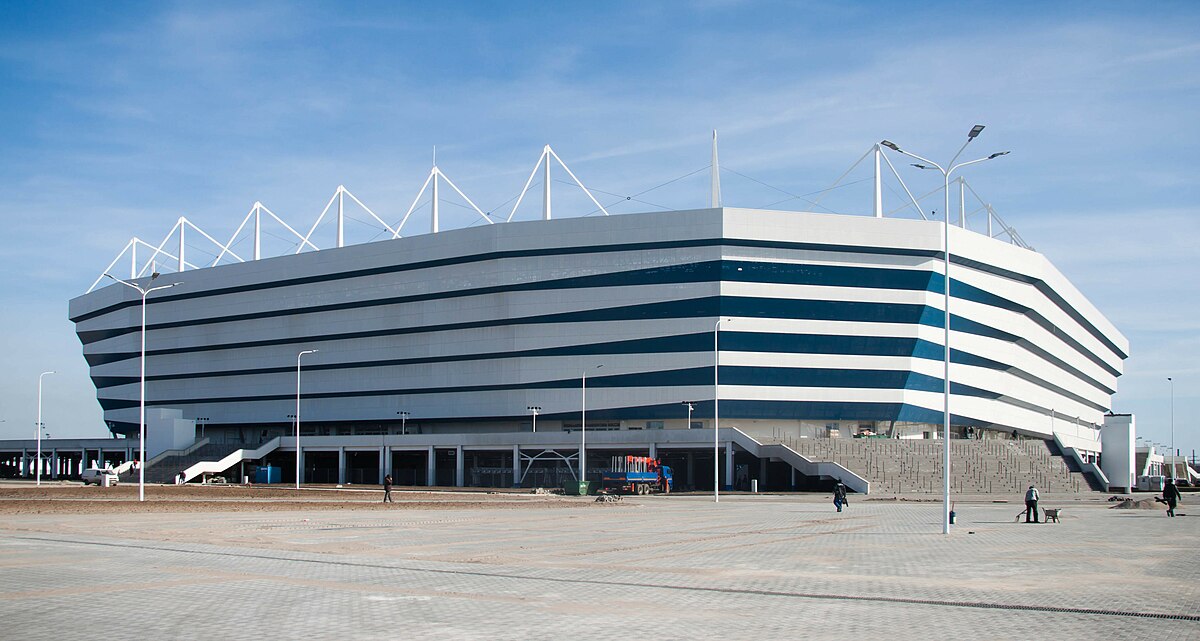
Smallest venue: Kaliningrad Stadium (35,212 seats)
Average no. of matches per venue: 5.33

Moscow
Luzhniki Stadium | Capacity: 80,000 seats | Opening: 1956
Matches:
14 June 2018 18:00 – Russia vs Saudi Arabia – Group A
17 June 2018 18:00 – Germany vs Mexico – Group F
20 June 2018 15:00 – Portugal vs Morocco – Group B
26 June 2018 17:00 – Denmark vs France – Group C
1 July 2018 17:00 – 1B vs 2A – Round of 16
11 July 2018 21:00 – W59 vs W60 – Semi Final
15 July 2018 18:00 – W61 vs W62 – Final

Saint Petersburg
Saint Petersburg Stadium | Capacity: 67,000 seats | Opening: 2017
Matches:
15 June 2018 17:00 – Morocco vs Iran – Group B
19 June 2018 21:00 – Russia vs Egypt – Group A
22 June 2018 15:00 – Brazil vs Costa Rica – Group E
26 June 2018 21:00 – Nigeria vs Argentina – Group D
3 July 2018 17:00 – 1F vs 2E – Round of 16
10 July 2018 21:00 – W57 vs W58 – Semi Final
14 July 2018 17:00 – L61 vs L62 – Third Place

Sochi
Fisht Stadium | Capacity: 48,000 seats | Opening: 2013
Matches:
15 June 2018 21:00 – Portugal vs Spain – Group B
18 June 2018 18:00 – Belgium vs Panama – Group G
23 June 2018 18:00 – Germany vs Sweden – Group F
26 June 2018 17:00 – Australia vs Peru – Group C
30 June 2018 21:00 – 1A vs 2B – Round of 16
7 July 2018 21:00 – W51 vs W52 – Quarter Final

Ekaterinburg
Ekaterinburg Arena | Capacity: 45,000 seats | Opening: 1957

Matches:
15 June 2018 17:00 – Egypt vs Uruguay – Group A
21 June 2018 17:00 – France vs Peru – Group C
24 June 2018 20:00 – Japan vs Senegal – Group H
27 June 2018 19:00 – Mexico vs Sweden – Group F

Kazan
Kazan Arena | Capacity: 45,000 seats | Opening: 2013

Matches:
16 June 2018 13:00 – France vs Australia – Group C
20 June 2018 21:00 – Iran vs Spain – Group B
24 June 2018 21:00 – Poland vs Colombia – Group H
27 June 2018 17:00 – Korea Republic vs Germany – Group F
30 June 2018 17:00 – 1C vs 2D – Round of 16
6 July 2018 21:00 – W53 vs W54 – Quarter Final

Nizhny Novgorod
Nizhny Novgorod Stadium | Capacity: 45,000 seats | Opening: 2018

Matches:
18 June 2018 15:00 – Sweden vs Korea Republic – Group F
21 June 2018 21:00 – Argentina vs Croatia – Group D
24 June 2018 15:00 – England vs Panama – Group G
27 June 2018 21:00 – Switzerland vs Costa Rica – Group E
1 July 2018 21:00 – 1D vs 2C – Round of 16
6 July 2018 17:00 – W49 vs W50 – Quarter Final

Rostov-on-Don
Rostov Arena | Capacity: 45,000 seats | Opening: 2018
Matches:
17 June 2018 21:00 – Brazil vs Switzerland – Group E
20 June 2018 18:00 – Uruguay vs Saudi Arabia – Group A
23 June 2018 21:00 – Korea Republic vs Mexico – Group F
26 June 2018 21:00 – Iceland vs Croatia – Group D
2 July 2018 21:00 – 1G vs 2H – Round of 16

Samara
Samara Arena | Capacity: 45,000 seats | Opening: 2018

Matches:
17 June 2018 16:00 – Costa Rica vs Serbia – Group E
21 June 2018 19:00 – Denmark vs Australia – Group C
25 June 2018 18:00 – Uruguay vs Russia – Group A
28 June 2018 18:00 – Senegal vs Colombia – Group H
2 July 2018 18:00 – 1E vs 2F – Round of 16
7 July 2018 18:00 – W55 vs W56 – Quarter Final

Saransk
Mordovia Arena | Capacity: 45,000 seats | Opening: 2018
Mordovia Arena

Matches:
16 June 2018 19:00 – Peru vs Denmark – Group C
19 June 2018 18:00 – Colombia vs Japan – Group H
25 June 2018 21:00 – Iran vs Portugal – Group B
28 June 2018 21:00 – Panama vs Tunisia – Group G

Volgograd
Volgograd Stadium | Capacity: 45,000 seats | Opening: 2018

Matches:
18 June 2018 21:00 – Tunisia vs England – Group G
22 June 2018 18:00 – Nigeria vs Iceland – Group D
25 June 2018 17:00 – Saudi Arabia vs Egypt – Group A
28 June 2018 17:00 – Japan vs Poland – Group H

Moscow
Spartak Stadium | Capacity: 42,000 seats | Opening: 2014

Matches:
16 June 2018 16:00 – Argentina vs Iceland – Group D
19 June 2018 15:00 – Poland vs Senegal – Group H
23 June 2018 15:00 – Belgium vs Tunisia – Group B
26 June 2018 17:00 – Serbia vs Brazil – Group C
3 July 2018 21:00 – 1H vs 2G – Round of 16

Kaliningrad
Kaliningrad Stadium | Capacity: 35,212 seats | Opening: 2018

Matches:
16 June 2018 21:00 – Croatia vs Nigeria – Group D
22 June 2018 20:00 – Serbia vs Switzerland – Group E
25 June 2018 20:00 – Spain vs Morocco – Group B
28 June 2018 20:00 – England vs Belgium – Group G


Source: http://www.stadiumguide.com/tournaments/fifa-world-cup-2018/

Elon Musk Biography

April 05, 2018
Elon Musk Biography
Explorer, Engineer, Inventor

South African entrepreneur Elon Musk is known for founding Tesla Motors and SpaceX, which launched a landmark commercial spacecraft in 2012.

Who Is Elon Musk?
Elon Reeve Musk (born June 28, 1971) is a South African-born American entrepreneur and businessman who founded X.com in 1999 (which later became PayPal), SpaceX in 2002 and Tesla Motors in 2003. Musk became a multimillionaire in his late 20s when he sold his start-up company, Zip2, to a division of Compaq Computers. Musk made headlines in May 2012, when SpaceX launched a rocket that would send the first commercial vehicle to the International Space Station. He bolstered his portfolio with the purchase of SolarCity in 2016, and cemented his standing as a leader of industry by taking on an advisory role in the early days of President Donald Trump's administration.


Elon Musk’s Net Worth
As of December 2017, Elon Musk’s net worth is $20.2 billion, according to Forbes. He earned his first billion with the sale of PayPal in 2002; his company SpaceX is valued at more than $20 billion.

Education
At age 17, in 1989, Elon Musk moved to Canada to attend Queen’s University and avoid mandatory service in the South African military. He left in 1992 to study business and physics at the University of Pennsylvania. He graduated with an undergraduate degree in economics and stayed for a second bachelor’s degree in physics.

After leaving Penn, Elon Musk headed to Stanford University in California to pursue a PhD in energy physics. However, his move was timed perfectly with the Internet boom, and he dropped out of Stanford after just two days to become a part of it, launching his first company, Zip2 Corporation. An online city guide, Zip2 was soon providing content for the new websites of both The New York Times and the Chicago Tribune. In 1999, a division of Compaq Computer Corporation bought Zip2 for $307 million in cash and $34 million in stock options.

PayPal
In 1999, Musk co-founded X.com, an online financial services/payments company. An X.com acquisition the following year led to the creation of PayPal as it is known today, and in October 2002, PayPal was acquired by eBay for $1.5 billion in stock. Before the sale, Musk owned 11 percent of PayPal stock.

Founder of SpaceX
Musk founded his third company, Space Exploration Technologies Corporation, or SpaceX, in 2002 with the intention of building spacecraft for commercial space travel. By 2008, SpaceX was well established, and NASA awarded the company the contract to handle cargo transport for the International Space Station—with plans for astronaut transport in the future—in a move to replace NASA’s own space shuttle missions.

Falcon 9 Rockets
On May 22, 2012, Musk and SpaceX made history when the company launched its Falcon 9 rocket into space with an unmanned capsule. The vehicle was sent to the International Space Station with 1,000 pounds of supplies for the astronauts stationed there, marking the first time a private company had sent a spacecraft to the International Space Station. Of the launch, Musk was quoted as saying, "I feel very lucky. ... For us, it's like winning the Super Bowl."

In December 2013, a Falcon 9 successfully carried a satellite to geosynchronous transfer orbit, a distance at which the satellite would lock into an orbital path that matched the Earth's rotation. In February 2015, SpaceX launched another Falcon 9 fitted with the Deep Space Climate Observatory (DSCOVR) satellite, aiming to observe the extreme emissions from the sun that affect power grids and communications systems on Earth.

In March 2017, SpaceX saw the successful test flight and landing of a Falcon 9 rocket made from reusable parts, a development that opened the door for more affordable space travel. A setback came in November 2017, when an explosion occurred during a test of the company's new Block 5 Merlin engine. SpaceX reported that no one was hurt, and that the issue would not hamper its planned rollout of a future generation of Falcon 9 rockets.

The company enjoyed another milestone moment in February 2018 with the successful test launch of the powerful Falcon Heavy rocket. Armed with additional Falcon 9 boosters, the Falcon Heavy was designed to carry immense payloads into orbit and potentially serve as a vessel for deep space missions. For the test launch, the Falcon Heavy was given a payload of Musk's cherry-red Tesla Roadster, equipped with cameras to "provide some epic views" for the vehicle's planned orbit around the sun.

BFR Mission to Mars
In September 2017, Musk presented an updated design plan for his BFR (an acronym for either "Big F---ing Rocket" or "Big Falcon Rocket"), a 31-engine behemoth topped by a spaceship capable of carrying at least 100 people. He revealed that SpaceX was aiming to launch the first cargo missions to Mars with the vehicle in 2022, as part of his overarching goal of colonizing the Red Planet.

In March 2018, the entrepreneur told an audience at the annual South by Southwest festival in Austin, Texas, that he hoped to have the BFR ready for short flights early the following year, while delivering a knowing nod at his previous problems with meeting deadlines.

Internet Satellites
In late March 2018, SpaceX received permission from the U.S. government to launch a fleet of satellites into low orbit for the purpose of providing Internet service. Ideally, the system would make broadband service more accessible for people in rural areas, while also boosting competition in heavily populated markets that are typically dominated by one or two providers. Critics countered that such a system would present a safety hazard with the skies above us cluttered by debris.

Founder & CEO of Tesla
Elon Musk is the co-founder, CEO and product architect at Tesla Motors, a company dedicated to producing affordable, mass-market electric cars as well as battery products and solar roofs. Musk oversees all product development, engineering and design of the company's products.

Five years after its formation, in 2008, the company unveiled the Roadster, a sports car capable of accelerating from 0 to 60 mph in 3.7 seconds, as well traveling nearly 250 miles between charges of its lithium ion battery. With a stake in the company taken by Daimler and a strategic partnership with Toyota, Tesla Motors launched its initial public offering in June 2010, raising $226 million.

Additional successes include the Model S, the company's first electric sedan. Capable of covering 265 miles between charges, the Model S was honored as the 2013 Car of the Year by Motor Trend magazine.

In April 2017, Tesla announced that it surpassed General Motors to become the most valuable U.S. car maker. The news was an obvious boon to Tesla, which was looking to ramp up production and release its Model 3 sedan later that year.

In November 2017, Musk made another splash with the unveiling of the new Tesla Semi and Roadster at the company's design studio. The semi truck, which enters into production in 2019, boasts 500 miles of range as well as a battery and motors built to last 1 million miles. The Roadster, set to follow in 2020, will become the fastest production car ever made with its 0 to 60 time of 1.9 seconds.

After initially aiming to produce 5,000 new Model 3 cars per week by December 2017, Musk pushed that goal back to March 2018, and then to June with the start of the new year. The announced delay didn't surprise industry experts, who were well aware of the company's production problems, though some questioned how long investors would remain patient with the process.

By April 2018, with Tesla expected to fall short of first-quarter production forecasts, news surfaced that Musk had pushed aside the head of engineering to personally oversee efforts in that division. In a Twitter exchange with a reporter, Musk said it was important to "divide and conquer" to meet production goals and was "back to sleeping at factory."

That year, Tesla announced a radical new compensation package for its CEO, in which Musk would be paid only if he reached milestones of growing  valuation based on $50 billion increments. At the top end of that chart, if Tesla reached a company value of $650 billion, then Musk stood to benefit from a stock award worth as much as $55 billion. In March, two of Tesla's largest shareholders indicated they would support the compensation package, valued at $2.6 billion, as a show of confidence in the company's CEO.

SolarCity Acquisition
In August 2016, in Musk’s continuing effort to promote and advance sustainable energy and products for a wider consumer base, a $2.6 billion dollar deal was solidified to combine his electric car and solar energy companies. His Tesla Motors Inc. announced an all-stock deal purchase of SolarCity Corp., a company Musk had helped his cousins start in 2006. He is a majority shareholder in each entity.

“Solar and storage are at their best when they're combined. As one company, Tesla (storage) and SolarCity (solar) can create fully integrated residential, commercial and grid-scale products that improve the way that energy is generated, stored and consumed,” read a statement on Tesla’s website about the deal.

Elon Musk’s Wives
Elon Musk has been married twice. He wed Justine Wilson in 2000. After a contentious divorce, Musk met actress Talulah Riley, and the couple married in 2010. They split in 2012 but married each other again in 2013. Their relationship ultimately ended in divorce in 2016. Musk has also been involved in an on-again, off-again relationship with actress Amber Heard.

Kids
Elon Musk has five sons with ex-wife Justine Wilson. In 2002, his first son with died at 10 weeks old from sudden infant death syndrome (SIDS). Musk and Wilson had five additional sons together: twins and triplets.

Birthday & Nationality
Elon Musk was born on June 28, 1971, in Pretoria, South Africa. He obtained his Canadian citizenship in 1989, in part because he felt it would be easier to obtain American citizenship via that path. In 2002, he achieved his goal of becoming a U.S. citizen.

Family and Early Life
Son of a Canadian mother and a South African father, Elon Musk spent his early childhood with his brother Kimbal and sister Tosca in South Africa. At 10, around the time his parents divorced, the introverted Elon developed an interest in computers. He taught himself how to program, and when he was 12 he made his first software sale of a game he created called Blastar.

Other Inventions & Innovations
Outside of his roles at SpaceX and Tesla, Musk has continually attempted to make his innovative ideas a reality.

Hyperloop
In August 2013, Elon Musk released a concept for a new form of transportation called the "Hyperloop," an invention that would foster commuting between major cities while severely cutting travel time. Ideally resistant to weather and powered by renewable energy, the Hyperloop would propel riders in pods through a network of low-pressure tubes at speeds reaching more than 700 mph. Musk noted that the Hyperloop could take from seven to 10 years to be built and ready for use.

Although he introduced the Hyperloop with claims that it would be safer than a plane or train, with an estimated cost of $6 billion — approximately one-tenth of the cost for the rail system planned by the state of California — Musk's concept has drawn skepticism. Nevertheless, the entrepreneur has sought to encourage the development of this idea. After he announced a competition for teams to submit their designs for a Hyperloop pod prototype, the first Hyperloop Pod Competition was held at the SpaceX facility in January 2017.

AI
Elon Musk has pursued an interest in Artificial Intelligence, becoming co-chair of the nonprofit OpenAI. The research company launched in late 2015 with the stated mission of advancing digital intelligence to benefit humanity. In 2017, it was also revealed that Musk was backing a venture called Neuralink, which intends to create devices to be implanted in the human brain and help people merge with software.

Boring Company
In yet another innovation, in January 2017 Elon Musk suddenly decided he was going find a way to reduce traffic by devoting resources to boring and building tunnels. He launched his venture, named "The Boring Company," with a test dig on the SpaceX property in Los Angeles. In late October, Musk posted the first photo of his company's progress to his Instagram page. He said the 500-foot tunnel, which would generally run parallel to Interstate 405, would reach a length of two miles in approximately four months.

The entrepreneur also reportedly found a market for the Boring Company's flamethrowers; after announcing they were going on sale for $500 apiece in late January 2018, he claimed to have sold 10,000 of them within a day.

High-Speed Train
In late November 2017, after Chicago Mayor Rahm Emanuel asked for proposals to build and operate a high-speed rail line that would transport passengers from O'Hare Airport to downtown Chicago in 20 minutes or less, Musk tweeted that he was all-in on the competition with his Boring Company. He said that the concept of the Chicago loop would be different from his Hyperloop, its relatively short route not requiring the need for drawing a vacuum to eliminate air friction.

Trump Adviser
With Donald Trump announcing plans to pursue massive infrastructure developments after his successful election to the U.S. presidency in 2016, Musk found himself on common ground with the new president and his advisers. That December, he was named to President Trump’s Strategy and Policy Forum, and the following January he joined Trump's Manufacturing Jobs Initiative.

While sometimes at odds with the president's controversial measures, such as a proposed ban on immigrants from Muslim-majority countries, Musk defended his involvement with the new administration. "My goals," he tweeted in early 2017, "are to accelerate the world’s transition to sustainable energy and to help make humanity a multi-planet civilization, a consequence of which will be the creating of hundreds of thousands of jobs and a more inspiring future for all." On June 1, following Trump's announcement that he was withdrawing the U.S. from the Paris climate accord, Musk stepped down from his advisory roles.

Elon Musk’s Nonprofit
The boundless potential of space exploration and the preservation of the future of the human race have become the cornerstones of Musk's abiding interests, and toward these he has founded the Musk Foundation, which is dedicated to space exploration and the discovery of renewable and clean energy sources.


Citation Information from
Article Title: Elon Musk Biography
Author: Website Name - The Biography.com website
Source: https://www.biography.com/people/elon-musk-20837159
Access Date: April 5, 2018
Publisher: A&E Television Networks
Last Updated: April 4, 2018
Original Published Date: n/a

roshankhapung


Thanks you for reading my blog! The reason why I created my own blog was to have the freedom to write about anything intrested in.


Recent

recentposts

Random

randomposts