VAR at the World Cup: What is the technology being used in Russia and how does it work?

June 19, 2018
The World Cup will put the greatest footballing nations on Earth to the test. But there is another trial happening, perhaps just as important and even more controversial: that of VAR, or the video assistant referee.

The technology is being used at the World Cup for the first ever time, and has the potential to fundamentally change games. It could decide the future of the tournament, by reversing some of the most important refereeing decisions in the game.

Proponents claim that VAR will ensure that decisions are fair and that the best team wins. But even those supporters admit that the technology is still at a very early stage – with supporters and referees still apparently confused about how it should actually be used.

How will VAR work in the Premier League?


Despite that complexity, the technology is fundamentally incredibly simple: it is an extra referee who watches the game and advises officials on decisions. In practise, though, it might be very complicated indeed.

How does it work?

There are 13 officials who can be chosen as the video assistant referee. They will all sit in a special hub in Moscow – no matter where the game is happening – and they will do so wearing their full kit, as if they were ready to jump onto the pitch at any time.

Of those, one will be chosen for each game, and they will have a team of three assistants.
In there, they will receive a stream from inside the stadium, which is made up of the view from a whole host of cameras – including slow motion ones – which the referees can flick between.

The VAR will watch the whole of each game. If they see something wrong, they can flag it to the referee; if the referee thinks something is wrong, he can get in touch with the VAR.

Either way, the VAR is only advisory. Any decision ultimately rests with the referee, even if he has advised the opposite way by the VAR.
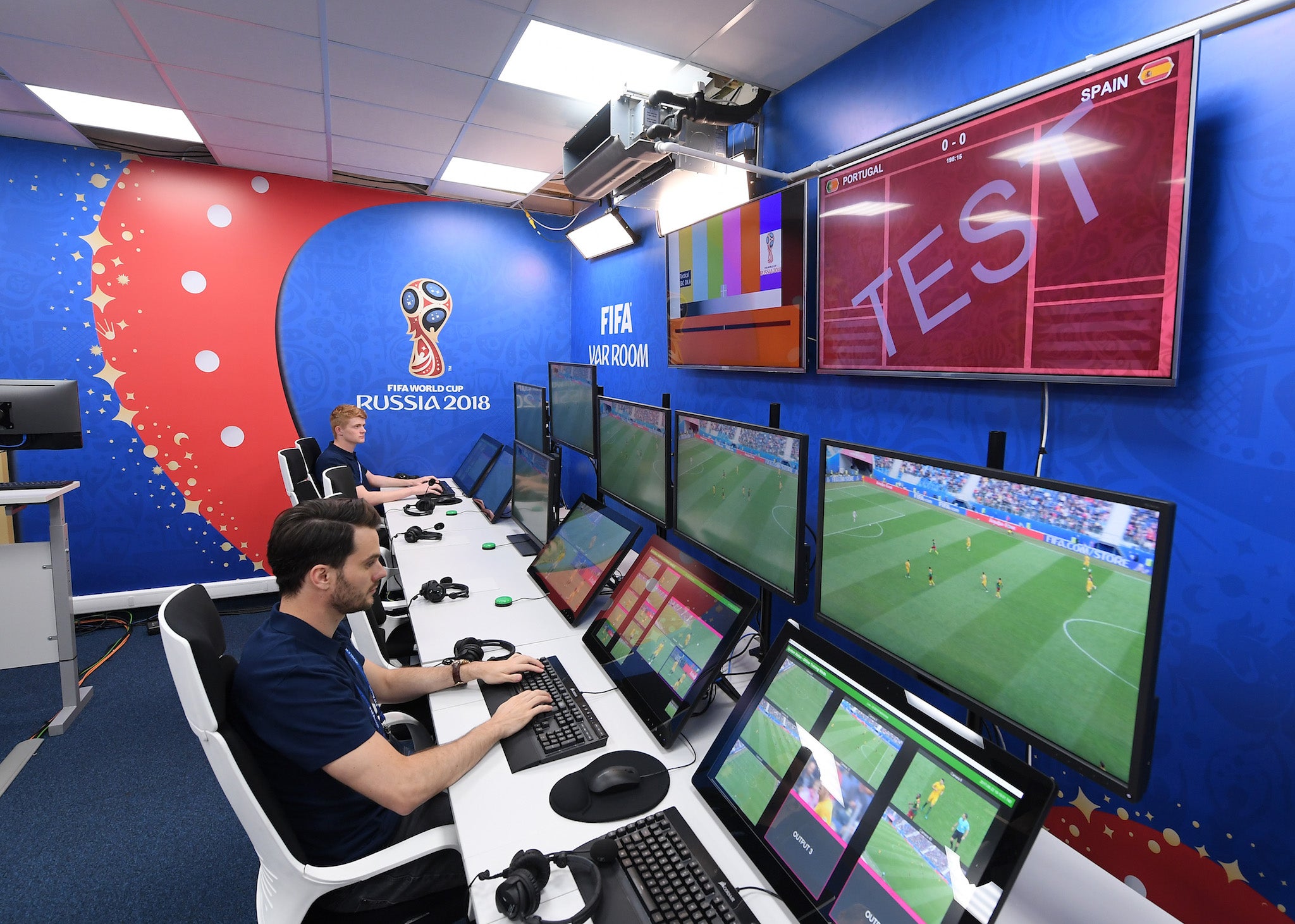

A general view of the Video Assistant Referee's Room home of the VAR system to be used at all FIFA World Cup matches during the Official Opening of the International Broadcast Centre on June 9, 2018 in Moscow, Russia (Laurence Griffiths/Getty Images)

What can be referred to the video referee?

Fifa might have allowed the technology into the World Cup. But they have severely limited the kinds of decisions it can actually be used for.

In total, there are four different sorts of incident that can be reviewed:
  • Goals. The system can be used to check if a goal actually went in, in the obvious way. But it can also adjudicate on the lead-up to the goal, not just the ball passing into the net – if an infringement would have stopped the goal being rewarded, then VAR can stop it being awarded.
  • Penalties. This can go either way, being used to check whether a penalty should have been awarded and wasn't, but also reversing the decision if a foul is given in the penalty box.
  • Red cards. If the referee has decided a foul has been committed, then VAR can be used to decide whether a red card should be awarded. This might be the most controversial thing that the video technology will be relied on for, for reasons we will get onto later.
  • Mistaken identity. Probably the most vague but also important parts of VAR's responsibility, this will allow the additional referees to spot if the wrong player has been disciplined. If they are, the referee will be corrected. That should stop situations like the mix-up between Kieran Gibbs and Alex Oxlade-Chamberlain that saw the wrong player sent off during a match in 2014.


How do you know when it's happening?

The entire system of VAR is focused around the referees, not around spectators. Which means the priority is not on making clear when or whether the system is being used.

It can be engaged in one of three ways.

In some situations, the referee might simply get a message in their earpiece, indicating that a decision is being reviewed. They'll get word from the VAR referees, who might tell them to change or stick with a decision. Spectators might not even know this is happening, or just see the referee touch their earpiece.

Another sees the video process engaged more formally, and the referee will draw a rectangle in the air to indicate a TV. That can be triggered by either the referee or the VAR judges, who will again have a word through the earpiece. The decision will be relayed to the referee, who will then make the rectangle sign again and carry on with the match.

The final one is the most clear, but could be the most confusing and frustrating in the stadium. Referees will head over to a small reviewing station on the side of the pitch – making the TV sign as they do – where they will also be able to see the same replays that are being shown to the VAR officials. They'll then consult together and make their decision.

In all cases, the decision will be made clear in the normal way – by the traditional referee signalling the decision, in the same way as without VAR. They might make the rectangle TV sign in the air to indicate how the decision was made, but then will continue in the usual way.

What can spectators see?

Perhaps the strangest and most confusing part of VAR is the fact that spectators won't actually get to see any of the replays, or even necessarily know what is happening. At most, they'll see the referee make the TV screen sign and perhaps head off to watch the pitch-side review.

But viewers at home will get to see the same pictures the referees are being shown, so the decision should not be quite so shocking. (This only goes one way: the referees don't get to see any broadcast images, or hear any commentary.)

Does it make any difference to players?

In the more direct sense – that is, discounting any arguments about whether it will change the pace of games – VAR doesn't allow players to do anything specific. In fact, the only significant rule change is what players can't do: they must not make the VAR sign themselves, in the same way they can't pretend to hold up a yellow card to someone as part of a protest, and they can be booked if they try it.

Why is it so controversial?
It took a long time for VAR to be introduced. And that was partly because many people fear it could ruin the flow and feel of the game.

Critics suggest that referees flagging up decisions using VAR – and then taking time to review footage and make their decision – could cause disruptions in play. And they also suggest that it will take away the important nuance that is part of refereeing, butting into matches to decide on any incident that relies on shades of grey.

Proponents have dismissed that idea. Earlier this year, refereeing body PGMOL stressed that the system would only interrupt games when there were very clear problems – "the rule of thumb is essentially 'if it’s not clear and obvious, leave it', and 'minimum interference, maximum benefit'," The Independent's Miguel Delaney wrote at the time.

But in use, the technology has been far from clear.

At a friendly match between Italy and England just weeks ago, a bizarre decision saw the video referee award a penalty – but that fact came after minutes of unexplained contemplation, and was not very well communicated to spectators. That came after similar events at Tottenham, which saw Spurs have two games disallowed during an FA Cup game, but after a lengthy disruption to play.

Officials might now be more used to using the technology, and working together. But we won't know until a World Cup match is interrupted.

Are there any changes being made for the World Cup?

The previous confusing instances have led to some changes for this competition. Fifa will be able to use a special tablet to send information to spectators and broadcasters, which should hopefully give them a bit more of a sense of what is actually happening while decisions are being made.

Is it likely to make a difference to decisions?

A study released this week found that slow-motion videos and real-time ones mostly led to the same decisions: in the experiment, referees were 63 per cent right when they watched an incident slowed down, compared with 61 per cent at normal speed.

But it found that slowing down videos seemed to severely change the way that referees saw intention. Watching in slow-motion made them far more likely to think that a foul had been done on purpose – and therefore considerably more likely to give a red card.

By
Andrew Griffin 
Jun 16, 2018

Google says its AI is better at predicting death than hospitals

June 19, 2018


Google’s Medical Brain team is now training its AI to predict the death risk among hospital patients — and its early results show it has slightly higher accuracy than a hospital’s own warning system.

Bloomberg describes the healthcare potential of the Medical Brain’s findings, including its ability to use previously unusable information in order to reach its predictions. The AI, once fed this data, made predictions about the likelihood of death, discharge, and readmission.

In a paper published in Nature in May from Google’s team, it says of its predictive algorithm:

These models outperformed traditional, clinically-used predictive models in all cases. We believe that this approach can be used to create accurate and scalable predictions for a variety of clinical scenarios.

In one major case study in the findings, Google applied its algorithm to a patient with metastatic breast cancer. 24 hours after she was admitted, Google gave her a 19.9 percent chance of dying in the hospital, in contrast with the 9.3 estimate with the hospital’s augmented Early Warning Score. Less than 2 weeks later, the patient died from her condition.

In order to come to that number, the AI tallied 175,639 data points from the patient’s electronic medical records, including handwritten notes. According to the paper, this is the difference between Google’s work and previous deep learning approaches:

In general, prior work has focused on a subset of features available in the EHR, rather than on all data available in an EHR, which includes clinical free-text notes, as well as large amounts of structured and semi-structured data.

In its whole study, Google analyzed 216,221 hospitalizations with 114,003 patients — and over 46 billion data points from all of their electronic health records.

This isn’t the first time Google’s AI has been applied to predictive healthcare. Earlier this year, DeepMind partnered with the Department of Veterans Affairs to feed its AI 700,000 medical records from veterans in order to predict deadly changes in patient condition.

The company is also working to develop a voice recognition system for clinical notes which will eliminate the need for doctors to type them in. In that particular case, the challenge comes from inaccuracy — even the smallest mistakes in a patient’s record can result in them getting the wrong care. Dr Steven Lin, who spearheaded the research with Google, told CNBC:

This is even more of a complicated, hard problem than we originally thought. But if solved, it can potentially unshackle physicians from EHRs and bring providers back to the joys of medicine: actually interacting with patients.

If Google can both smooth the process of entering data and improve the means by which that data is used, it could cut down on human error in medical care.

The company’s greatest challenge — the data in this case isn’t available for security reasons. In 2016, the company faced backlash from patients when it was revealed it’d gained access to the data of 1.6 million patients — without consent — from three hospitals in London in order to develop an app which notified doctors when a patient was likely to get kidney disease.

It could also stoke fears of an AI having too much say over who gets what care. If a patient is given a significantly higher risk than another, will the hospital allocate more resources to the former based on the AI’s prediction?

By
Rachel Kaser
Jun 19, 2018

“Learn with Google AI” website offers free machine learning education for all

June 17, 2018
Google introduces “Learn with Google AI” website to educate people about machine learning and AI for free

Artificial Intelligence (AI) and machine learning (ML) are currently some of the trending topics in the tech industry. Google wants to make AI and ML more accessible to more people by providing lessons, tutorials and hands-on exercises at all experience levels.

Therefore, Google India on Thursday (March 1) introduced a new website called “Learn with Google AI” that encourages everyone to understand how AI works, learn about core ML concepts, develop skills and apply AI to solve real-world challenging problems. These educational resources are developed by ML experts at the company and caters to everyone, from beginners to researchers looking for advanced tutorials.

“We believe it’s important that the development of AI reflects as diverse a range of human perspectives and needs as possible. So, Google AI is making it easier for everyone to learn ML by providing a huge range of free, in-depth educational content,” Zuri Kemp, Programme Manager for Google’s machine learning education, said in a statement.

“This is for everyone — from deep ML experts looking for advanced developer tutorials and materials, to curious people who are ready to try to learn what ML is in the first place,” Kemp added.

“Learn with Google AI” also offers a free online course called the new Machine Learning Crash Course (MLCC), which features videos from ML experts at Google, interactive visualizations illustrating ML concepts, coding exercises using cutting-edge TensorFlow (TF) APIs, and A focus that teaches how practitioners implement ML in the real world.

“Our engineering education team originally developed this fast-paced, practical introduction to machine learning fundamentals for Googlers. So far, more than 18,000 Googlers have enrolled in MLCC, applying lessons from the course to enhance camera calibration for Daydream devices, build virtual reality for Google Earth, and improve streaming quality at YouTube. MLCC’s success at Google inspired us to make it available to everyone,” added Kemp.

The course’s duration is estimated at 15 hours, with interactive lessons, lectures from Google researchers, and over 40 exercises included. The course can be availed by newcomers as well as those who have no experience in ML. However, Google suggests that students should have proficiency at least in intro-level algebra, programming basics, and Python.

“There’s more to come from Learn with Google AI, including additional courses and documentation. We’re excited to help everyone learn more about AI,” said Kemp.

By Kavita Iyer
March 4, 2018

2018 FIFA World Cup

June 13, 2018

The 2018 FIFA World Cup will be the 21st FIFA World Cup, a quadrennial international football tournament contested by the men's national teams of the member associations of FIFA. It is scheduled to take place in Russia from 14 June to 15 July 2018, after the country was awarded the hosting rights on 2 December 2010.
The final tournament will involve 32 national teams, which include 31 teams determined through qualifying competitions and the automatically qualified host team. Of the 32 teams, 20 will be making back-to-back appearances following the last tournament in 2014, including defending champions Germany, while Iceland and Panama will both be making their first appearances at a FIFA World Cup. A total of 64 matches will be played in 12 venues located in 11 cities. The final will take place on 15 July at the Luzhniki Stadium in Moscow.


Source: https://en.wikipedia.org/wiki/2018_FIFA_World_Cup

2018 FIFA World Cup Team


Source: https://www.fifa.com/worldcup/teams/

FIFA World Cup 2018 Stadiums

Teams: 32
Playing venues: 12
Matches: 65
Opening match: Luzhniki Stadium
Final: Luzhniki Stadium
Average venue capacity: 49,300 seats
Largest venue: Luzhniki Stadium (81,000 seats)
Smallest venue: Kaliningrad Stadium (35,212 seats)
Average no. of matches per venue: 5.33

Moscow
Luzhniki Stadium | Capacity: 80,000 seats | Opening: 1956
Matches:
14 June 2018 18:00 – Russia vs Saudi Arabia – Group A
17 June 2018 18:00 – Germany vs Mexico – Group F
20 June 2018 15:00 – Portugal vs Morocco – Group B
26 June 2018 17:00 – Denmark vs France – Group C
1 July 2018 17:00 – 1B vs 2A – Round of 16
11 July 2018 21:00 – W59 vs W60 – Semi Final
15 July 2018 18:00 – W61 vs W62 – Final

Saint Petersburg
Saint Petersburg Stadium | Capacity: 67,000 seats | Opening: 2017
Matches:
15 June 2018 17:00 – Morocco vs Iran – Group B
19 June 2018 21:00 – Russia vs Egypt – Group A
22 June 2018 15:00 – Brazil vs Costa Rica – Group E
26 June 2018 21:00 – Nigeria vs Argentina – Group D
3 July 2018 17:00 – 1F vs 2E – Round of 16
10 July 2018 21:00 – W57 vs W58 – Semi Final
14 July 2018 17:00 – L61 vs L62 – Third Place

Sochi
Fisht Stadium | Capacity: 48,000 seats | Opening: 2013
Matches:
15 June 2018 21:00 – Portugal vs Spain – Group B
18 June 2018 18:00 – Belgium vs Panama – Group G
23 June 2018 18:00 – Germany vs Sweden – Group F
26 June 2018 17:00 – Australia vs Peru – Group C
30 June 2018 21:00 – 1A vs 2B – Round of 16
7 July 2018 21:00 – W51 vs W52 – Quarter Final

Ekaterinburg
Ekaterinburg Arena | Capacity: 45,000 seats | Opening: 1957

Matches:
15 June 2018 17:00 – Egypt vs Uruguay – Group A
21 June 2018 17:00 – France vs Peru – Group C
24 June 2018 20:00 – Japan vs Senegal – Group H
27 June 2018 19:00 – Mexico vs Sweden – Group F

Kazan
Kazan Arena | Capacity: 45,000 seats | Opening: 2013

Matches:
16 June 2018 13:00 – France vs Australia – Group C
20 June 2018 21:00 – Iran vs Spain – Group B
24 June 2018 21:00 – Poland vs Colombia – Group H
27 June 2018 17:00 – Korea Republic vs Germany – Group F
30 June 2018 17:00 – 1C vs 2D – Round of 16
6 July 2018 21:00 – W53 vs W54 – Quarter Final

Nizhny Novgorod
Nizhny Novgorod Stadium | Capacity: 45,000 seats | Opening: 2018

Matches:
18 June 2018 15:00 – Sweden vs Korea Republic – Group F
21 June 2018 21:00 – Argentina vs Croatia – Group D
24 June 2018 15:00 – England vs Panama – Group G
27 June 2018 21:00 – Switzerland vs Costa Rica – Group E
1 July 2018 21:00 – 1D vs 2C – Round of 16
6 July 2018 17:00 – W49 vs W50 – Quarter Final

Rostov-on-Don
Rostov Arena | Capacity: 45,000 seats | Opening: 2018
Matches:
17 June 2018 21:00 – Brazil vs Switzerland – Group E
20 June 2018 18:00 – Uruguay vs Saudi Arabia – Group A
23 June 2018 21:00 – Korea Republic vs Mexico – Group F
26 June 2018 21:00 – Iceland vs Croatia – Group D
2 July 2018 21:00 – 1G vs 2H – Round of 16

Samara
Samara Arena | Capacity: 45,000 seats | Opening: 2018

Matches:
17 June 2018 16:00 – Costa Rica vs Serbia – Group E
21 June 2018 19:00 – Denmark vs Australia – Group C
25 June 2018 18:00 – Uruguay vs Russia – Group A
28 June 2018 18:00 – Senegal vs Colombia – Group H
2 July 2018 18:00 – 1E vs 2F – Round of 16
7 July 2018 18:00 – W55 vs W56 – Quarter Final

Saransk
Mordovia Arena | Capacity: 45,000 seats | Opening: 2018
Mordovia Arena

Matches:
16 June 2018 19:00 – Peru vs Denmark – Group C
19 June 2018 18:00 – Colombia vs Japan – Group H
25 June 2018 21:00 – Iran vs Portugal – Group B
28 June 2018 21:00 – Panama vs Tunisia – Group G

Volgograd
Volgograd Stadium | Capacity: 45,000 seats | Opening: 2018

Matches:
18 June 2018 21:00 – Tunisia vs England – Group G
22 June 2018 18:00 – Nigeria vs Iceland – Group D
25 June 2018 17:00 – Saudi Arabia vs Egypt – Group A
28 June 2018 17:00 – Japan vs Poland – Group H

Moscow
Spartak Stadium | Capacity: 42,000 seats | Opening: 2014

Matches:
16 June 2018 16:00 – Argentina vs Iceland – Group D
19 June 2018 15:00 – Poland vs Senegal – Group H
23 June 2018 15:00 – Belgium vs Tunisia – Group B
26 June 2018 17:00 – Serbia vs Brazil – Group C
3 July 2018 21:00 – 1H vs 2G – Round of 16

Kaliningrad
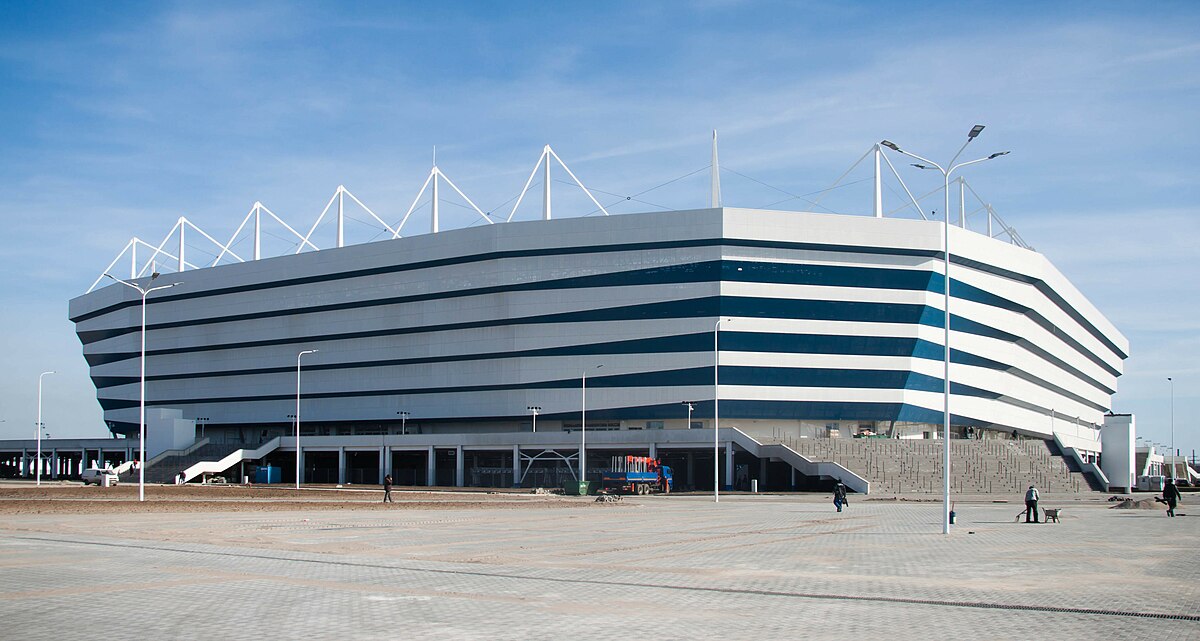
Kaliningrad Stadium | Capacity: 35,212 seats | Opening: 2018

Matches:
16 June 2018 21:00 – Croatia vs Nigeria – Group D
22 June 2018 20:00 – Serbia vs Switzerland – Group E
25 June 2018 20:00 – Spain vs Morocco – Group B
28 June 2018 20:00 – England vs Belgium – Group G


Source: http://www.stadiumguide.com/tournaments/fifa-world-cup-2018/

Google bans AI for weapon use

June 09, 2018

Google has promised not to use AI for weapons, following protests over its partnership with the US military.

A decision to provide machine-learning tools to analyse drone footage caused some employees to resign.

Google told employees last week it would not renew its contract with the US Department of Defense when it expires next year.

It has now said it will not use AI for technology that causes injury to people.

The new guidelines for AI use were outlined in a blog post from chief executive Sundar Pichai.

He said the firm would not design AI for:
  • technologies that cause or are likely to cause overall harm
  • weapons or other technologies whose principal purpose is to cause or directly facilitate injury to people
  • technology that gathers or uses information for surveillance violating internationally accepted norms
  • technologies whose purpose contravenes widely accepted principles of international law and human rights

He also laid out seven more principles which he said would guide the design of AI systems in future:
  • AI should be socially beneficial
  • It should avoid creating or reinforcing bias
  • Be built and tested for safety
  • Be accountable
  • Incorporate privacy design principles
  • Uphold high standards of scientific excellence
  • Be made available for use

When Google revealed that it had signed a contract to share its AI technology with the Pentagon, a number of employees resigned and thousands of others signed a protest petition.

Project Maven involves using machine learning to distinguish people and objects in drone videos.

The Electronic Frontier Foundation welcomed the change of heart, calling it a "big win for ethical AI principles".

8 June 2018
By BBC NEWS
Image result for bbc logo

roshankhapung


Thanks you for reading my blog! The reason why I created my own blog was to have the freedom to write about anything intrested in.


Recent

recentposts

Random

randomposts